Wednesday, January 17, 2007

Yen-Wang-Yeh and a chinese dragon

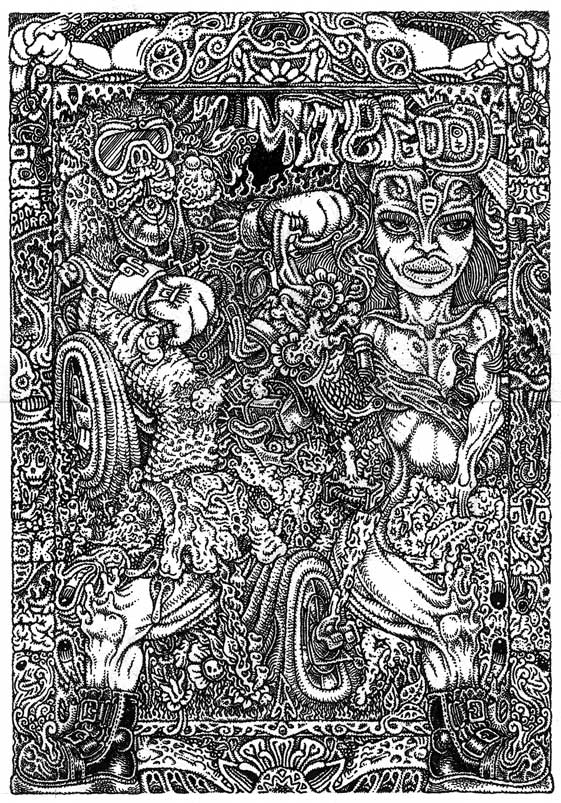
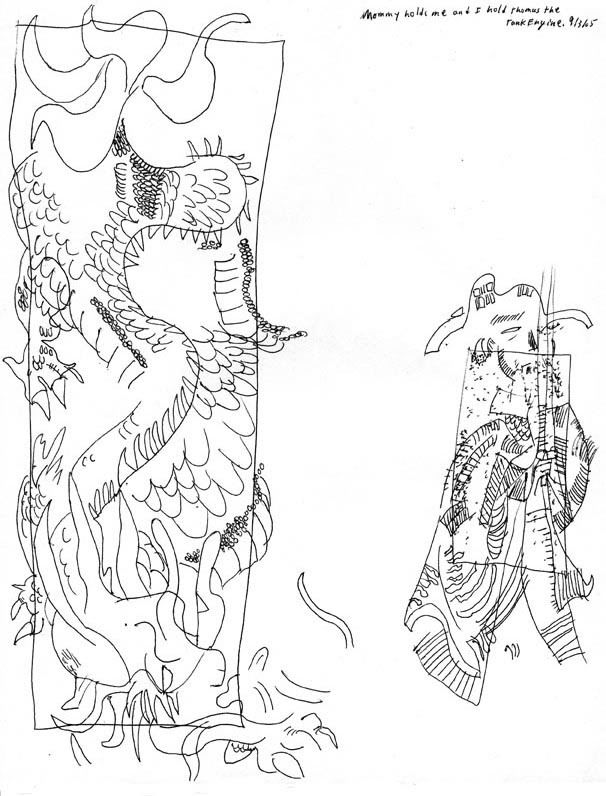
Yen-wang-yeh is the judge of the dead; the chinese dragon is a chinese dragon.


The text reads "Mommy hold me and I hold Thomas the Tank Engine."

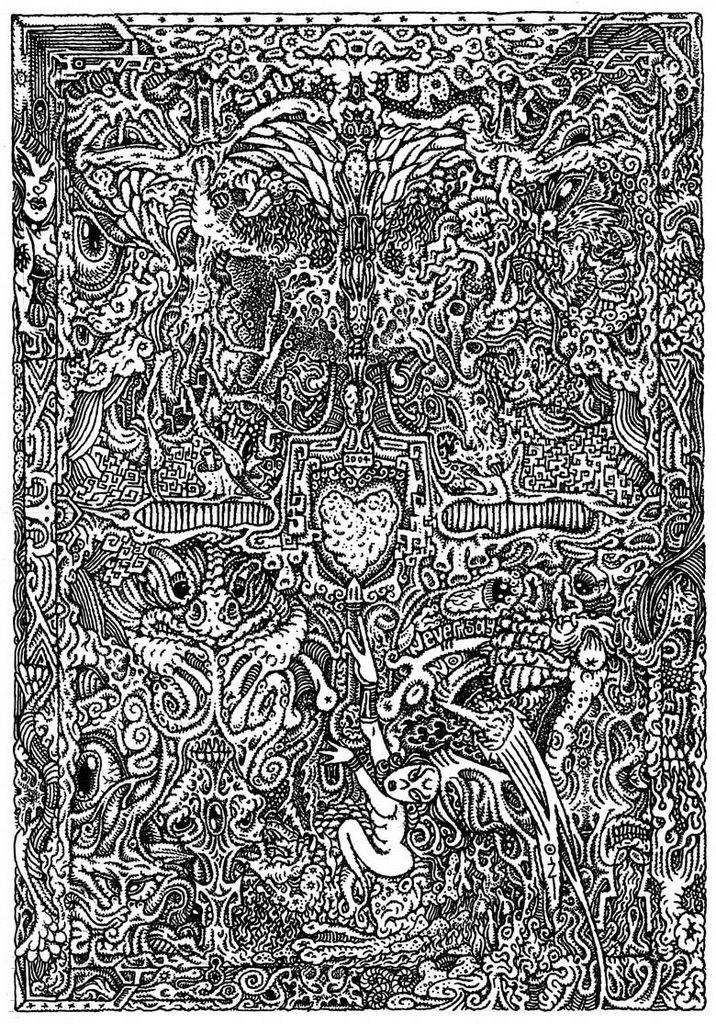
I got to draw a lot of dragons during this project.

Tuesday, January 16, 2007

Blam & Blast

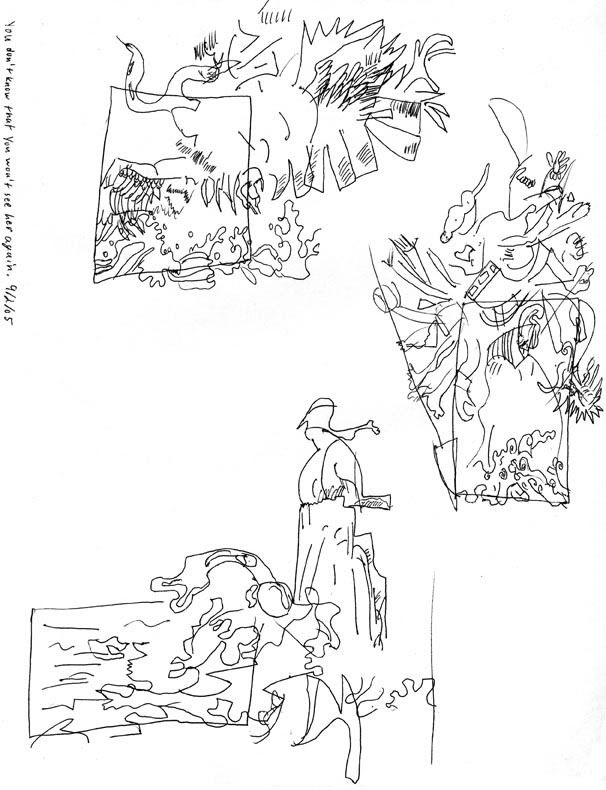
back in the saddle -- Shan Hai ching and You Mu

Shan Hai Ching is the god of wind and sea; there are two pictures of him, and one of Tou Mu, the multi-armed goddess of the north star.


The quote is "You don't know that you won't see her again."

Luke's very kindly set up an archive blog for me, so if you want to see the full evolution from "really, really can't draw to save his life" to "really can't draw to save his life," you can check it out here:

http://piagetanddemigods.blogspot.com/

Monday, January 15, 2007

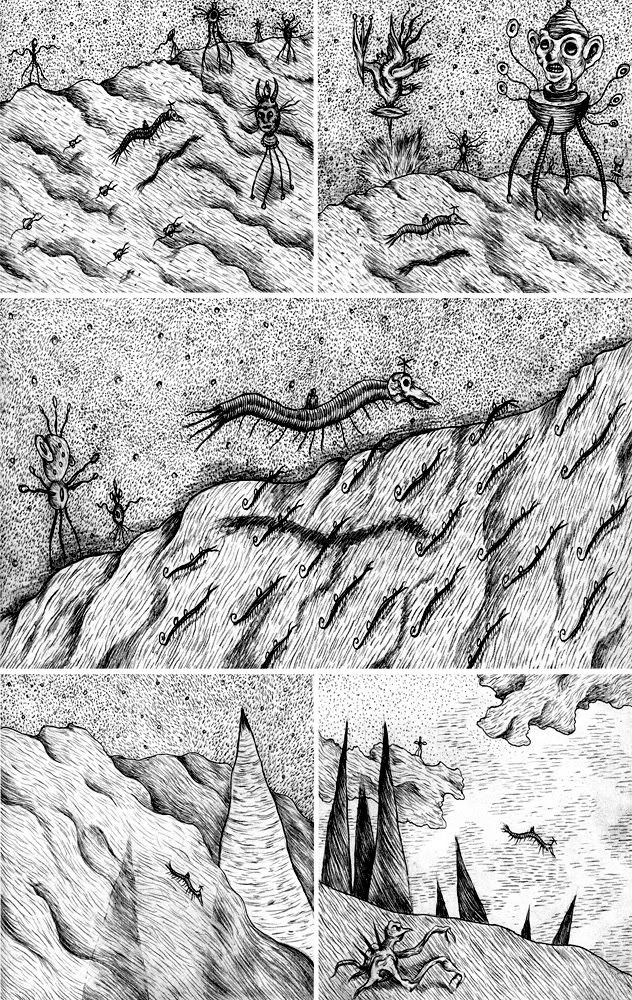
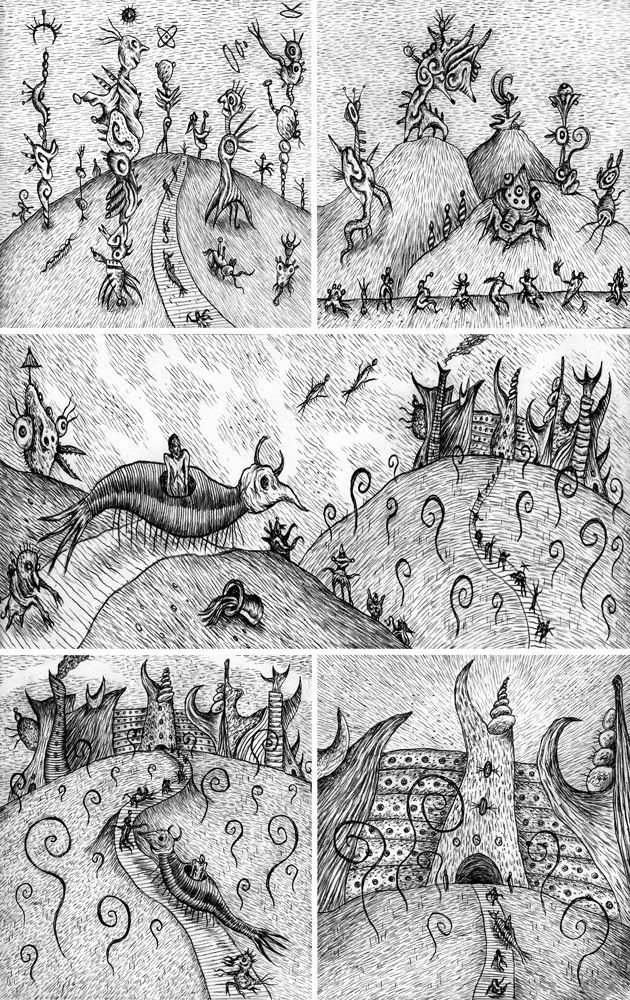
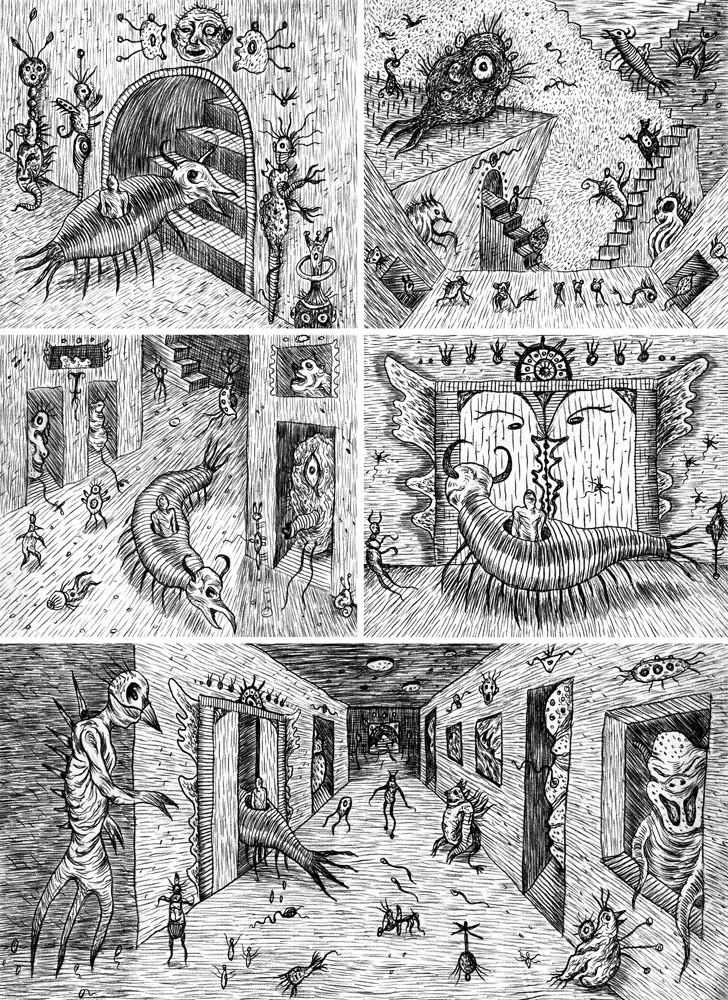
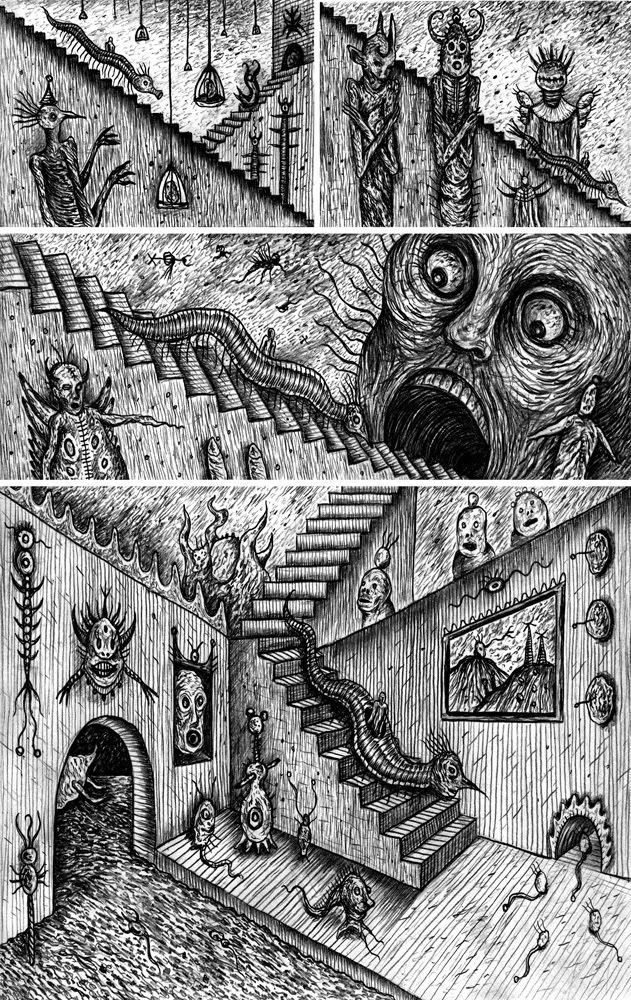
Strange World - Pages 26 - 40


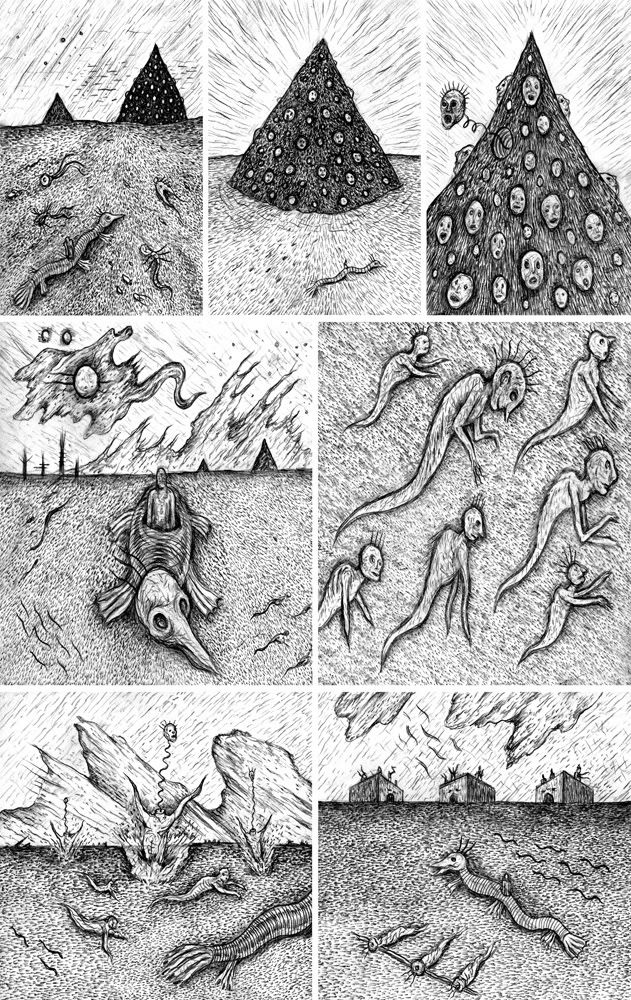
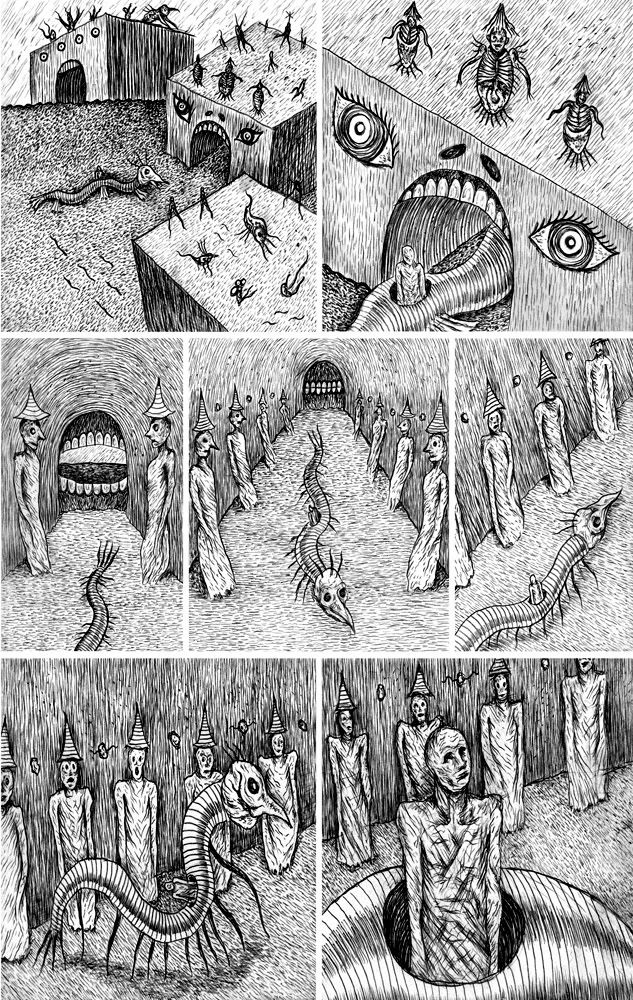
26 - 27 - 28 - 29 - 30 - 31 - 32 - 33 - 34 - 35 - 36

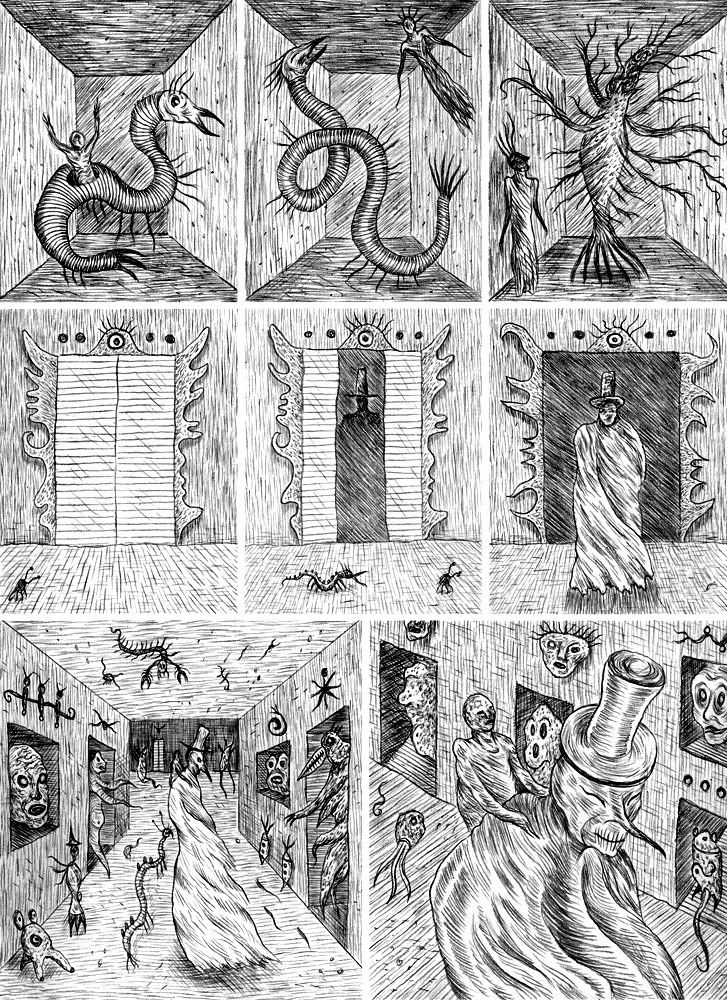
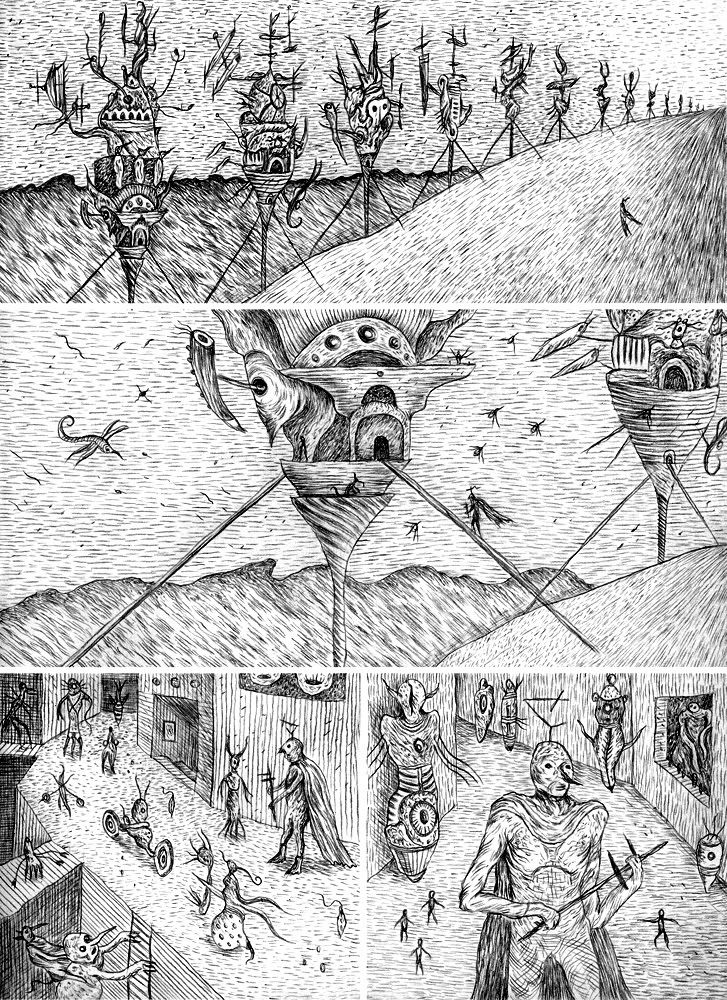
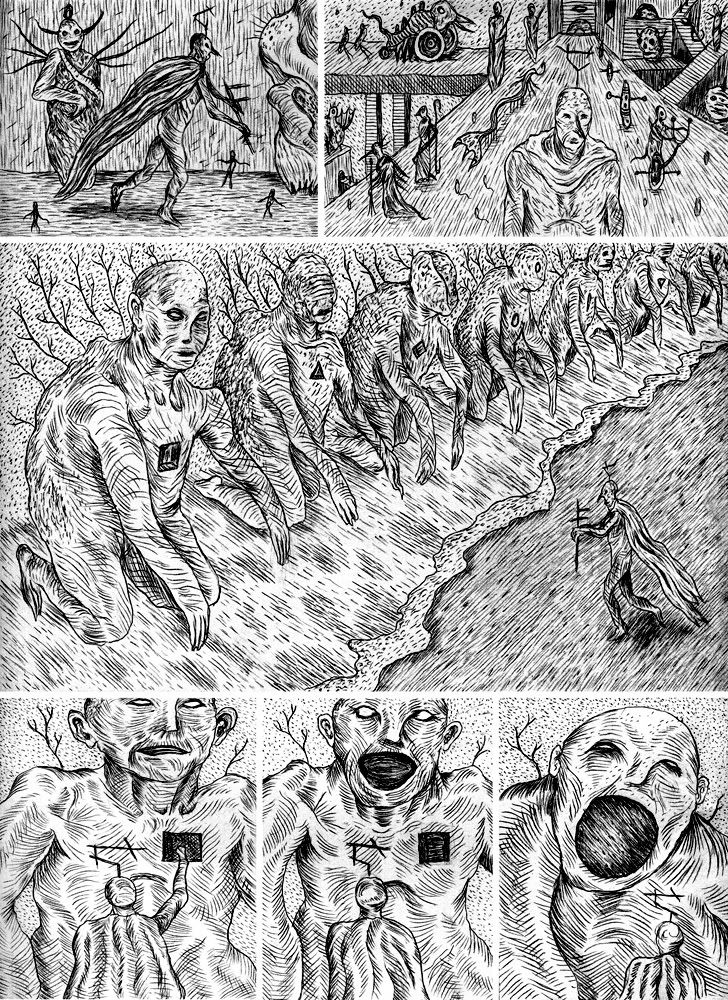
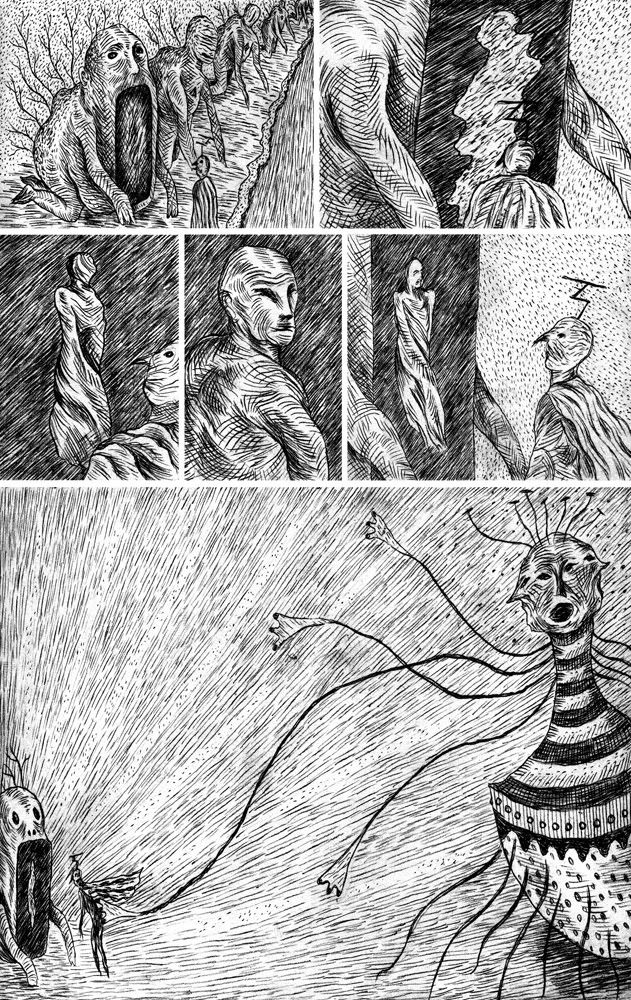
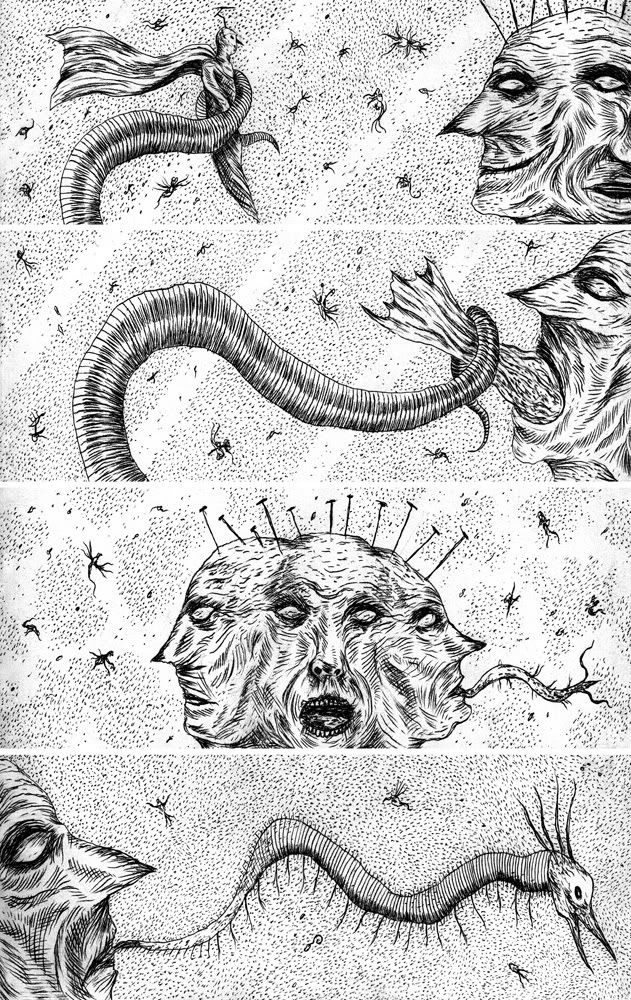
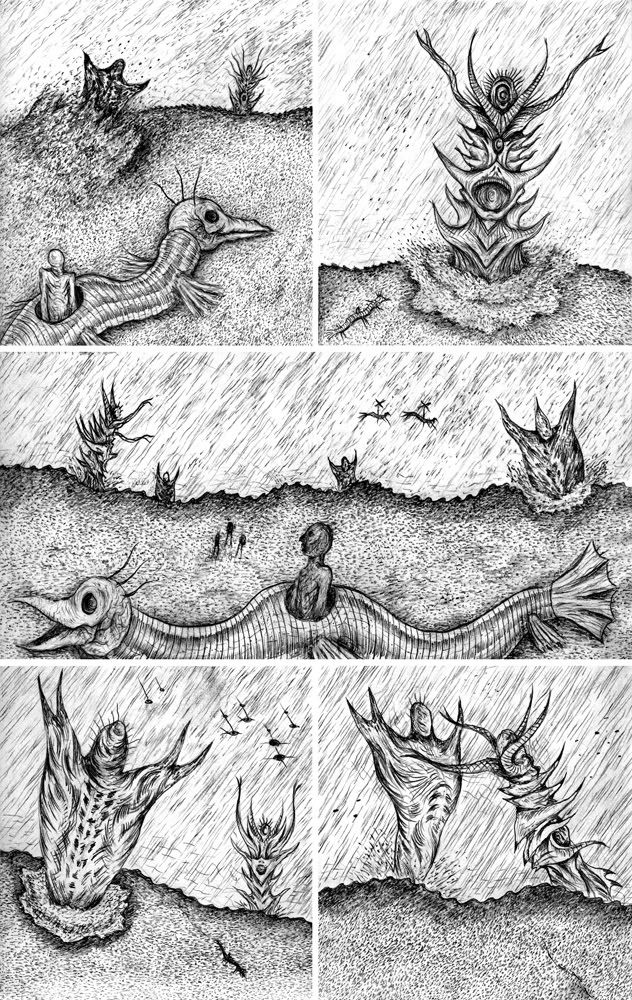
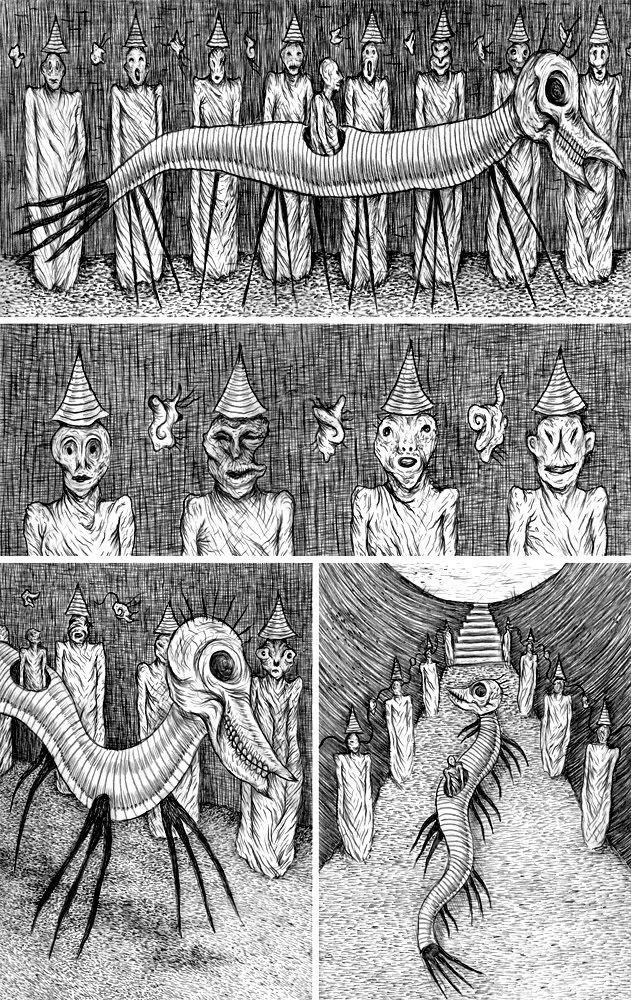
epilogue 1 - 2 - 3 - 4

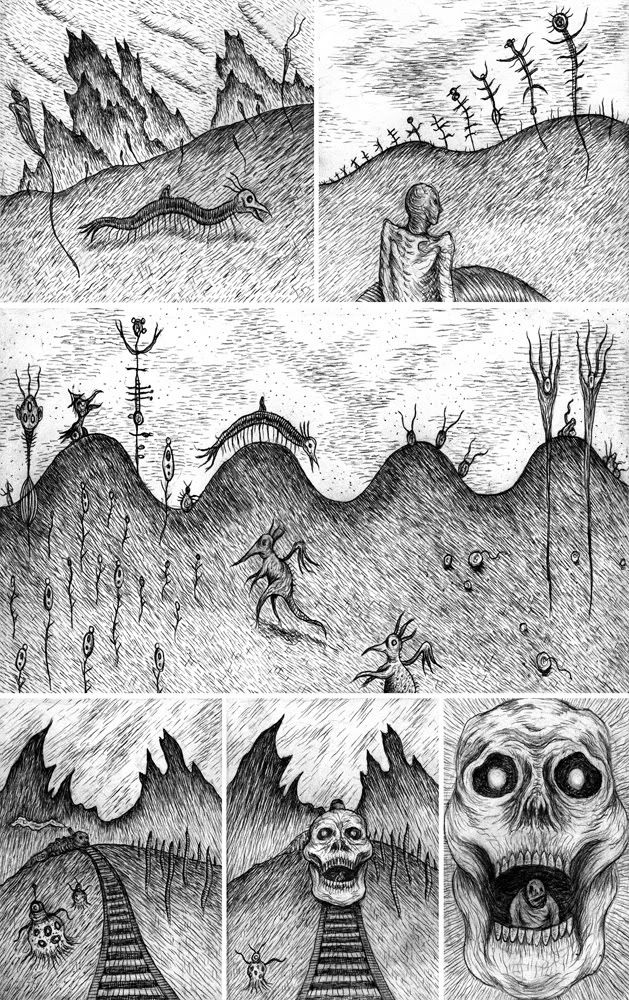
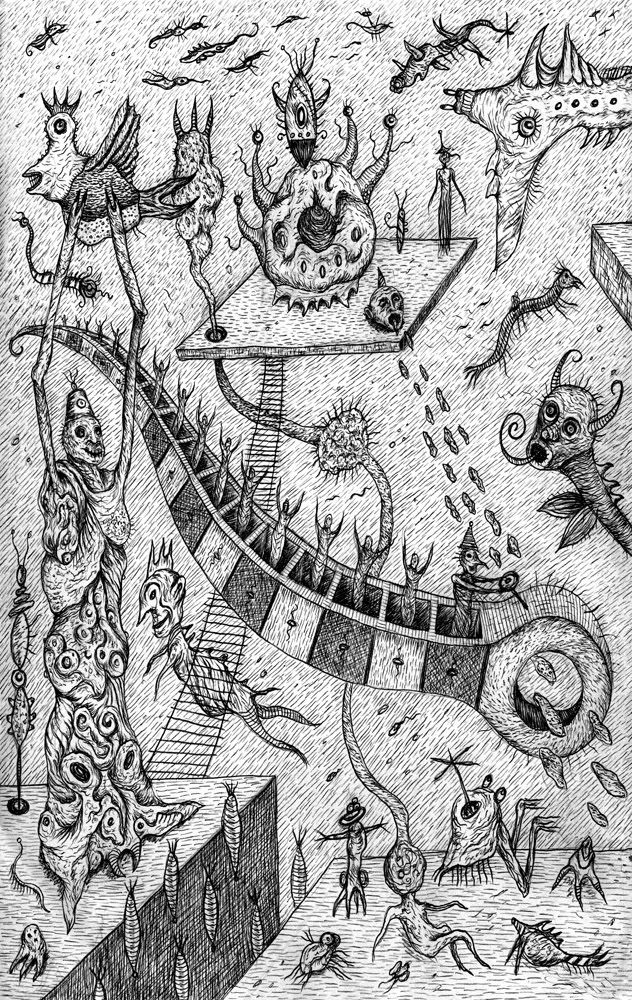
And there's Strange World. It could do with some tweaks here and there, some more cleaning up, but that's the book and it was an interesting experiment that taught me a lot of things about making comics. I'd originaly scripted out another 300 pages for this book that I abandoned in favor of Hob Bob. A lot of what was going to go into future issue of this are now being merged into the Hob Bob book.

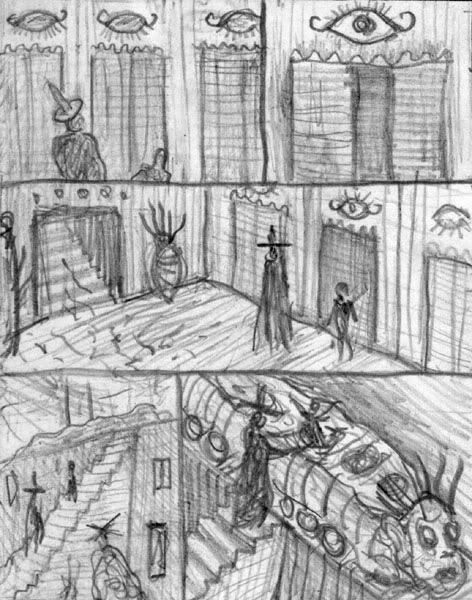
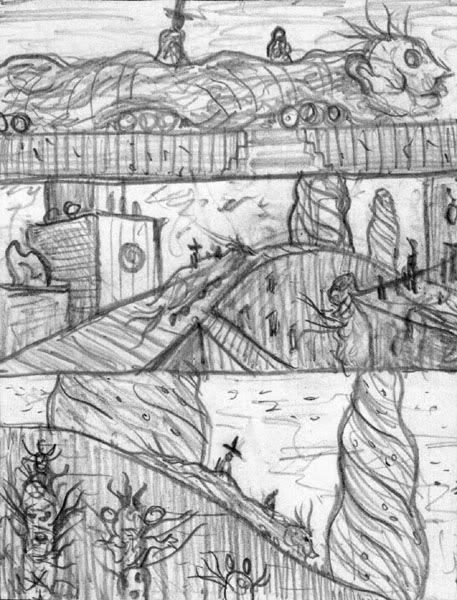
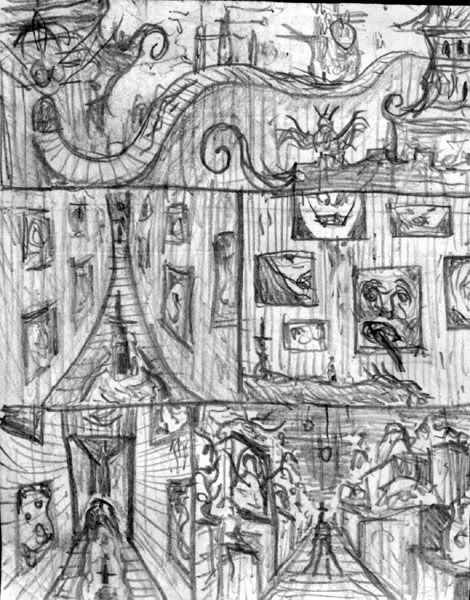
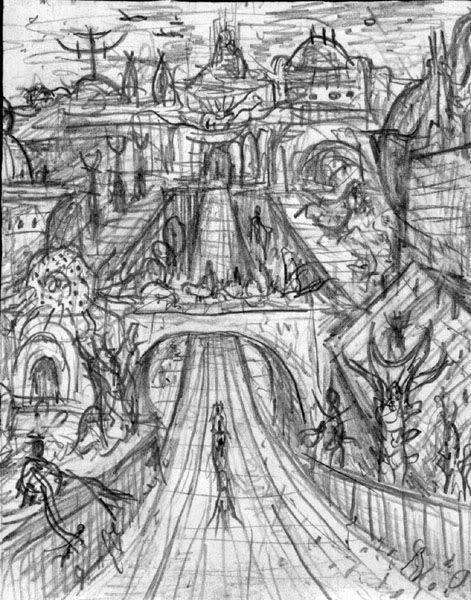
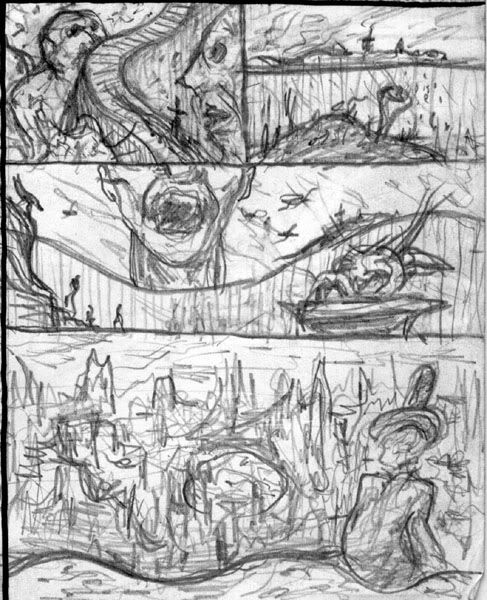
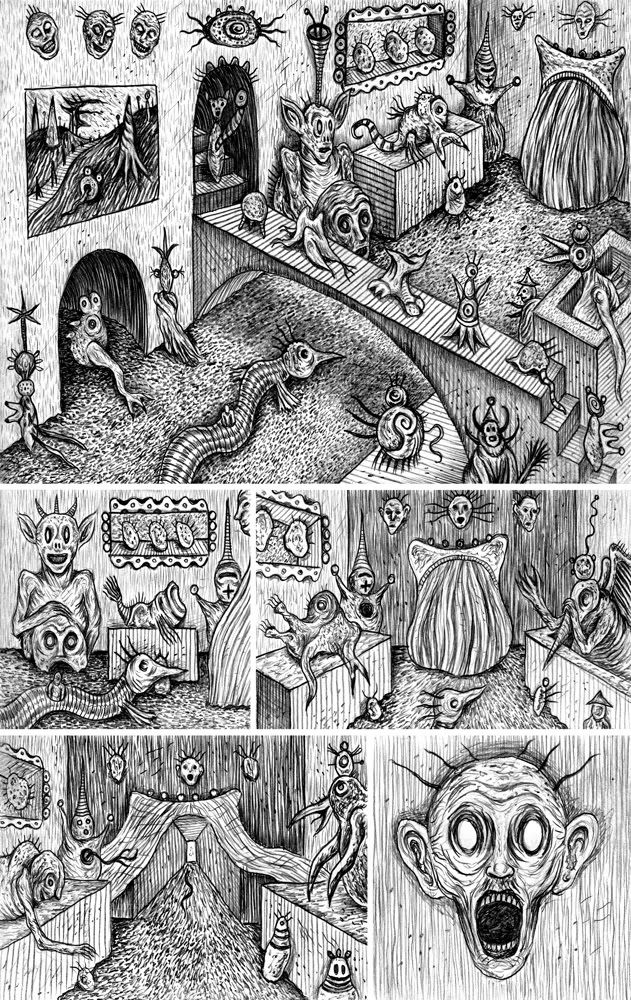
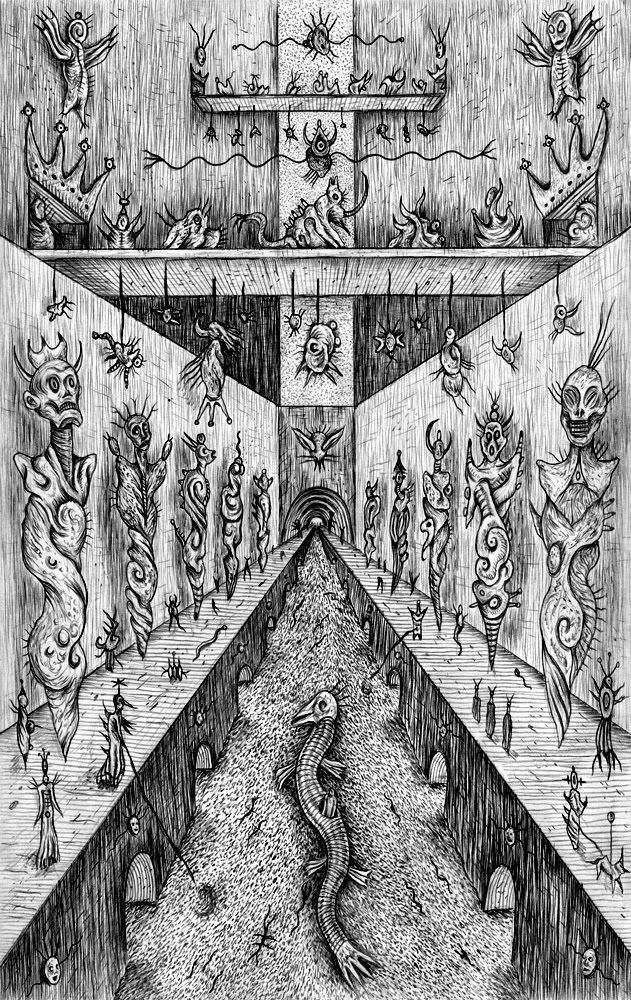
Here are some thumbnail sketch pages that were intended for a future issue of Strange World. In these The tall figure in the hat that is seen in the last pages of Strange World escapes with a fellow traveler from guardians of a palace where they were being imprisoned. These pages might be reworked into Hob Bob, not sure yet. 1 - 2 - 3 - 4 - 5 - 6

Sunday, January 14, 2007

Good & Evil?!


Me & Otto at his 1st Birthday Party. I look shockingly like my dad in this picture.

So, i've been thinking alot lately about Christianity & Satanism & Good & Evil. I normally argue that i don't believe in good & evil, because if i did believe in evil, i'd most likely argue that through their actions, most humans are evil, while i am good. If i go by my definition of what it means to be good, i've met very few actually good people. There are alot of people who give lip-service & intention towards good, these are the people i'd associate with Christianity, but in the end, their good intentions pave the road to hell, which is the road that most of them drive on. While most of the people i know who are interested in Satanism or evil are typically what i would call Good, in that they lead examined & conscious lives. That said, i don't spend time with the types of people are active in the Church of Satan, which seems like an attempt to rationalize & accept the American philosophy of economic & social exploitation.

What really got me thinking about all this was the book i'm reading, "The Spear of Destiny" by the amusingly named Trevor Ravenscroft which is one of these occult Hitlerism type books & re-reading the Hobbit while re-watching the Peter Jackson Lord of the Rings movies. Specifically what i got to thinking about was the idea that Hitler channeled this daemonic power using Black magic in order to have his meteoric rise to power. To me, this really ignores the material reality of politics, but on the other hand, i do believe in magic. Anyhow, here's the thing, i believe that Hitler thought he was doing good, even while obviously doing evil. So, why would Hitler use an evil daemonic energy if his intentions were good? A-ha! The answer is amusingly; Saruman! If Saruman thought he was doing good, ushering in the new age of Orcs, & the Orcs thought he was doing good, after they destroyed the world of man & elves & trees & Hobbits, the world would be good for Orcs & Wizards. Tolkien was a Catholic who believed that the Norse mythology would help usher in a new Western understanding of Christ, which would then make the world good. He despised the modern, bureaucratic, dehumanising industrial politics of Democratic Capitalism, Fascism, Socialism & Communism. Tolkien believed that the best thing would be agrarian anarchism, united under some sort of King. This is essentially my belief as well, & i do have a fair degree of Catholicism running in my mind. However, there are a large degree of people who would describe many actions of the Catholic Church as evil, rightly so. It's much the same with any poilitical system, they argue that they know what's best for humanity, but in their application, they end up crushing those that don't fit into their simplistic & impossible equation.

My Punk name is Sean Goblin, & i always related most to the Goblins & Trolls & didn't see them as evil. Now, to me Goblins & Trolls are kind of the same thing, except Trolls are much bigger & live in the woods while Goblins are small & live in caves or around rocks. They live in caves & cause trouble. To me, that's not evil, that's mischevious. In the Lord of the Rings, the Orcs (also known as Goblins) became evil servants of a Necromancer, they were revealed to be distorted creatures who were once elves & had been tortured & mutated with magic deep in the caves of Middle Earth I always felt like the Elves & Dwarves & Men would have loved to just kill all of the Goblins if they had the time & energy to do so. It was always apparent that the Goblins had the same right to live as the other races, except maybe when they are described as these magically distorted & tortured elves. By making them into perversions of this noble race, it makes it easier to dismiss them as having a right to live. Once again, i see a connection to Hitler or any politician who decides to "solve the problems" & "create perfection". The master race that Hitler wished to create seems like they would be little different than the Elves in Tolkien's world; a bunch of boring bastards.

To me, it is the complexity of the human character that makes us interesting & exciting. If the idea of "doing good" is accompanied by a great deal of "doing evil", intentional or not, it just doesn't seem like you are actually doing good. This ends up becoming a discussion of universal good (Killing the Orcs is good for the Elves) & relative or interest-based good (Killing the Jews is good for the Nazis, bad for the Jews). History shows that Hitler was the worst thing that could have ever happened to Germany & has made it nearly impossible to articulate true German pride or character post WWII. We can look at Saruman the confused Wizard thinking that by siding with Sauron, he would somehow be able to continue his life in any qualitiative manner after the world was covered in blood. The same goes for Stalin & the Communists, in seeking to solve the human problem, they had to smash with the hammer & cut with the sickle an estimated 110,000,000 citizens of their own regimes. Catholicism & Christianity, with the goal of a brotherhood of man & the successful transition of the dead into heaven are responsible for countless evils as well, in the name of good & God too.

All this said, i do believe in good. I don't think it is relative either, i believe in universal good. I don't believe you can solve the problem of the human condition & remain good however. As soon as politics & control are involved, you've made a trade. Solving the human condition is like asking animals to change their behavior, it's not going to happen. More on this later! Let's discuss.

Sub-missionary: Paper Tiger Comix

I thought a really pragmatic use for this blog might be to post about any worthy solicitations for submissions we come across. We're all at least somewhat interested in being published, no? Our own dear Limey Zeke alerted me to this little UK outfit called Paper Tiger, who're looking for contributior to their decidedly underground anthologies. They seem to have a kind of punk edge to them , which I'm not interested in. Good thing its tempered with stuff like cool painted covers like this here:
Photobucket - Video and Image Hosting

Anyhow, I submitted a drawing and the editor, Sean, accepted it.
The deal is pretty standard; one time use, no pay, etc. The only thing I find lacking in our arrangement is that I was told they could not afford to send each contributor a copy, which seems odd..*
It doesn't bother me too much though.
He's listed a few other anthologies as works in progress. I'm sure he wouldn't mind looking at a few jpegs you send his way.

Have you been solicited for submissions recently?
Should we put together our own anthology?

***NOTE***
The above-mentioned Sean has alerted me to his plans to provide a comp. copy for each contributor. Please keep this in mind.
Oh, and, thanks Sean.***
-Edited by Luke on 1-15-07

Another addendum/email from Sean:
"Hi Luke, I saw the blog entry on eatenbyducks.com for War/ paper Tiger, thanks for putting it on there, but I wondered if you could please make two changes. Firstly, all contributors will get a free complimentary copy of any anthologies they submit to, but i may have to ask half of the shipping costs for overseas contributors ....Also, could you mention that the deadlines for Paper Tiger Comix 4 and WAR is February 15th, and that the website hasn't been updated in a while so all enquiries should come through me

Thanks,
Sean"

Friday, January 12, 2007

Zen and the Art of Self-Satisfaction

This essay touches on some of the things we were talking about in the comments section on Sean's last post, so I thought I'd put it on the blog. A slightly revised version of this piece ran in The Baffler; I think it came out in 1999 or 2000. Anyway, it was my first published piece of criticism. I think the book I reviewed, "The Artist's Way," remains just about the worst book in the world (yes, worse even than "In the Shadow of No Towers").

Zen and the Art of Self-Satisfaction
Though The Artist's Way claims "to tap into the higher power that connects human creativity with the creative energies of the universe," what it really taps into is the same old shit. More specifically, The Artist's Way sounds, at times, exactly like contemporary poetry; at other times like economic theory; and at still other times like a combination of management consultant jargon, NPR commentary, and friendly academic feminist anthropology. There are, in fact, several bleak moments in which The Artist's Way sounds like all of these, and like everything else as well. Yet despite the motherload of verbal detritus which spills from its pages, the book never once compromises its truly awesome vacuity. It seems determined to make as little as possible from as much as possible: an ambition which, while amusing at first, quickly becomes seriously disorienting. The unwary reader may begin to feel that all that he has ever read or thought has been designed with the nefarious purpose of leading him to The Artist's Way , and there abandoning him. One finds oneself clutching the edges of the book a bit too hard, as if to prevent oneself from pitching forward into the page and falling forever into a bottomless and eerily familiar abyss.
It is an abyss which has already swallowed a large number of people. Originally published in 1992, The Artist's Way was marketed as "a spiritual path to higher creativity" -- a workbook for anyone who wanted to learn to become an artist. Since then, it has sold over a million copies, inspired numerous sequels, and been praised by many artists, including singer Kathy Mattea, who credits it with giving her a "new direction." It's basic thesis -- that everyone, deep down, is an artist -- has proved enormously popular: almost as popular as such better-known theses as "everyone, deep down, is equal," and "everyone, deep down, is free." These slogans are noteworthy not because they are inspirational, beautiful, or true, but because they are self-fulfilling. To say, with our founding fathers, that everyone, deep down, is equal is to ignore all those people who, up here, on the surface, clearly aren't. To say with The Artist's Way that everyone is an artist is, therefore, to be guilty of more than stupidity; it is to be guilty of willful blindness, and manifest bad faith. Indeed, The Artist's Way genuflects to the zeitgeist with such cunning efficiency that it attains a grandeur usually associated only with epoch-making documents like The Constitution of the United States and The Valley of the Dolls.
The Artist's Way is written -- to the extent that such a book can be said to be written -- by Julia Cameron, with the help of Mark Bryan. Mark Bryan is Cameron's former husband and an expert in "business creativity," which is all, I think, that needs to be said about *him*. Julia Cameron -- or "Little Julie" as she sometimes calls herself -- has an even more improbable past; she is a recovering alcoholic, Martin Scorcese's ex-wife, and a one-time writer for Rolling Stone, in approximately that order. That neither Cameron nor Bryan is an artist in the conventional sense may explain their utter disrespect for art in all its forms. Indeed, they seem to hate art, with a shallow, condescending hatred reminiscent of those grammar school teachers who loathe the unfortunate pupils they so mercilessly praise.
Duplicitous philistinism is, of course, a typically American vice, and notwithstanding its Mt. Fuji cover, The Artist's Way is a very American book. Like most self-help gurus, Julia Cameron has an American belief in the efficacy of individual action coupled with an even more American contempt for the individual: everyone, she argues, can learn to be successful, because everyone is a failure to begin with. "[W]e are all creative," she tells us in one breath, and then in the next, "all of us are [blocked] to some extent." We are all, in other words, failing to live up to our full potential as artists, much as welfare mothers fail to live up to their potential as entrepreneurs. This, naturally, is where Cameron's book comes in -- job training, as it were, for the aesthetically underprivileged.
Like job training, too, The Artist's Way, teaches no actual skills. Cameron avoids making even the most basic suggestions about the mechanisms of art -- nowhere does she indicate, for instance, that painters should learn how to mix paint, or that violinists need to practice regularly, or that poets should, at least occasionally, read poetry. This is because Cameron doesn't think of art as a craft, or even as a hobby -- she thinks of it, instead, as a health issue. If you are not an artist, you are unwell; to become an artist therefore requires not practice, but convalescence and "recovery." Cameron does not want to teach -- she wants to "daub and soothe and cool," and, in accordance with this desire, she has crafted a program based loosely on her own experience with Alcoholics Anonymous. Through twelve easy steps, blocked artists recovers a sense of "safety," "power," "abundance" -- a sense, in other words, that they have a rightful place at the center of the universe. This centrality is literal, not figurative: God himself is an artist, Cameron maintains, and "artists like other artists." With friends in such high places, one might think that artists were a pretty hardy group, but this is not the case: Cameron's book takes it for granted that the artist is barely held together by "self-nurturing" and self-pity. Spend quality time alone with your own "inner artist-child," Cameron says, or the little fella will curl up and die. Buy yourself "luxuries" like expensive perfume and "gold stick-'em stars" or your creativity will wither. Do what you want because "Artists cannot be held to anybody else's standards!" A good first act of self-assertion, Cameron suggests, might be dyeing your hair. (Cameron does not suggest getting a tattoo -- presumably this would be too far out, even for artists.)
Given their frailty, it should come as no surprise that criticism is very dangerous to most artists. Some criticism, Cameron reluctantly admits, can be useful, but most is "artistic child abuse," and "all that can be done with abusive criticism is to heal from it." As damaging as criticism from others is, however, self-criticism is worse. Artists need to think with their "artist brain," not with their "logic brain." The "Censor" -- the part of the mind which criticizes artistic output -- needs to be outwitted, and the way to do this is through the "morning pages": three pages of stream-of-consciousness writing to be done every morning for the rest of your life. To write morning pages, you put down on paper whatever comes into your head, without going back over it. In other words, the morning pages are freewriting, a staple of high school English courses, and a well-established way for writers to generate ideas. For Cameron, though "morning pages" are not the beginning of the writing process; they are, rather, a metaphor for all artistic endeavor. Art comes out of people naturally and unreflectively, like urine. The artist should not think about his work; he should, as minor filmmaker Martin Ritt says, "just do it." Cameron quotes Ritt several times in her book; she also quotes just about everyone else, from Oscar Wilde to Albert Einstein to Duke Ellington. She does not, however, quote Jonathan Swift, nor James Baldwin, nor Public Enemy, nor, for that matter, any other satirists or social critics. The reason is clear enough: for people like James Baldwin art is a form of thought, a way of engaging society by criticizing it, arguing with it, and challenging it. For Julia Cameron, on the other hand, art takes place outside of thought, outside of society, in a pseudo-Zen emptiness which would chill its inhabitants' blood if any of them could feel.
Cameron, of course, believes that she feels. To what has she sacrificed thought, history, and insight, if not to feeling? "Use your anxiety," she urges, "use your anger....gain in compassion by reparenting your wounded artist-child." Cameron believes that the artist should luxuriate in feeling, licking his dry lips in anticipation of each original emotional quiver. Unfortunately, such quivers are rarely either original or emotional -- save in the cramped, desperate way in which masturbation is emotional. Nothing exists in a vacuum, and feelings are no exception. One cannot disconnect art from society and expect it to be rewarding, emotionally or otherwise. Compare Kate Chopin, for example, with somebody like Jack Kerouac. Kerouac is arguably the better writer -- he has, at least, a better ear for language than Chopin does. But Chopin's stories are grounded in American society: in the ways in which Americans of different classes, races, and genders relate to one another. Kerouac, on the other hand, has nothing to talk about but his own peeved rebelliousness -- against what it is never clear -- and his vague desire to get away from everyone else so he can nurse his injuries in private. As a result, Chopin's writing is exhilarating, thought-provoking, funny, and occasionally moving, while the only emotion Kerouac inspires is a sort of lukewarm distrust -- a vague wish that he had taken the whole "on the road" thing a bit more seriously and had gone far, far away, preferably to a land without typewriters.
Today, alas, Chopin is largely ignored while Kerouac is a cultural icon whose banality and glibness seem in large part responsible for his popularity. Certainly Cameron's banality and glibness have stood her in good stead: The Artist's Way has made her a millionaire. American artists, it seems, desperately want to believe that they are outside society -- that they are, on the one hand, persecuted by their culture and, on the other, that they are connected to a secret, special source of power which makes them superior to their crass, misguided peers. Like Jesus or John Wayne, the artist wants to be both the persecuted outsider and the savior, both despised and worshipped. You must acknowledge and heal the injuries inflicted by those around you, Cameron tells her eager audience, so that you can become better than all of them.
Yet, though Cameron's artists are free of all social connections, they are also rather helplessly bourgeois. Art does not pay very well, and its practitioners, therefore, tend to be people who can afford to be frivolous. Among those who have successfully used The Artist's Way, according to Cameron are "Edwin, a miserable millionaire...Timothy, a ...curmudgeon millionaire," and "Phyllis, a leggy, racehorse socialite." A large part of the purpose of The Artist's Way, then, is to reassure Edwin, Timothy and Phyllis that, despite their vast wealth, they are really very nice; indeed, they are enormously talented and wonderful. The reason that they feel worthless is not because they have built their lives on treachery, deceit, and callousness, but because they were unjustly "wounded" by parents, teachers, and friends who told them that they could not have absolutely everything they wanted. The reason that things come easily to them is not because they are rich, but because the universe is organized to benefit artistic people like themselves. "...God is unlimited in supply and everyone has equal access... we deprive no one with our abundance," says Cameron. Through bitter experience, the people of the world have come to learn that such slogans are not a promise but a threat. They know that when we say that they are our equals, what we really mean is that we will take from them whatever we desire, and that we will not be sorry.
Some might argue that all of this is beside the point. The Artist's Way is, after all, a self-help book, not a philosophical treatise. It does not claim to offer political insight: what it claims is that it will make us more creative, and that it will make us happy. Most people who pick up The Artist's Way don't want to know if the book is good or bad; they want to know if it will help them -- that is, if it works. Many of us tend to forget that the list of things which work is long and not particularly glorious. Capitalism works. So does western medicine, fascism, advertising, and polling. So does slavery. Anything, in fact, will work, as long as you believe in it. But few Americans accept this. Instead we have allowed economists and therapists to convince us that the only way to judge everything from ideology to art to detergent is on the basis of whether it works and whether it makes us happy.
Let me say in its defense, then, that The Artist's Way works, and that it will make you happy. Some day, I feel certain, it will work so well that, across the country, men and women everywhere will rise, write their morning pages, and spend the rest of the day brimming with creative energy. On that day, painters, writers, performance artists and filmmakers will blissfully explore their childhood traumas and arrive at public healing strategies. Policemen will be filled with joy as they inventively and playfully beat a black man who has wandered into a gated community. Photographers will take rich, zesty pictures of anorexics, and publishers will think up exciting ways to convince female readers that they should look like those models. Lawyers heady with God-flow will brainstorm ways to legally drop people from the rolls of HMOs. But more than that, I see a day when the black man who is beaten doesn't mind, and the women who starves herself doesn't mind, and the cancerous child without health insurance doesn't mind either. For they, too, will be cultivating their own creativity. The man will aesthetically modulate his screams and be happy. The women will stick her fingers down her throat, vomit in an attractive pattern, and be happy. And the child's brain will be slowly, inevitably, and painlessly eaten away, as across his face spreads a comforting and meaningless smile.
Soft Terror Swamp-- LP

Thursday, January 11, 2007

TATTOO SPIRITUALISM IS SKIN DEEP.

There are certain things in this town in Oregon that really blow me away occassionally. For a while i've been amazed by the really stupid spiritual hippie dippie names the tattoo spots have. Here are their actual names. (for the record, i've met a bunch of the dudes who tattoo at these spots & they generally aren't bad at all, it's just the business names that drive up the fucking wall.)

High Priestess: They're primarily a piercing joint, which i'll get into later. This isn't so bad as a double entendre as this is a big glass-blowing patchouli location, but when i want to get tattooed or pierced by a priestess, high or not, i'll let you know. Here's language from their website.
"Those of us within the HPP family consider body modifications to not only represent a mind state or way of life, but a legitimate art form as well. It is perhaps humankind’s oldest form of self expressionism. It has been a right of passage for countless cultures and indigenous tribes as long as time can tell. We are a dedicated tribe of modern day primitives here to bring this ancient art form into our present world."
Spiritual Tree: Yes, Spiritual Tree. This is probably the stupidest name for a tattoo parlour or anything i've ever heard. "Oh man, it's like... it's like a SPIRITUAL TREE! Heavy!"
Sacred Space: Before the collapse of culture, women used to only get tattoos on their Sacred Space & maybe their ankle.
Evolved Ink: This ties with Spiritual Tree for most obnoxious name. I'm not sure if they are saying that they put nanomachines into the tattoo ink so that your tattoos hide when your mom sees you naked or what, but it isn't alright to call a tattoo shop "Evolved Ink". It's just not right.

IT'S A CON
What really set me off on this mission to clarify the place of tattoos in society was a High Priestess advert that said "decorate your soul". Jesus H. f*cking Christ! Tattoos are for the dregs of society, people living on the edge of a knife, not for wanna-be aesthetic buddhas. "Piercing your soul." "The crayon marks on your consciousness." "Metal pimples all over your body." It's not spiritual, it's body graffiti; skulls, knives, flowers, dice, snakes & chicks. That doesn't mean they aren't cool, it just means it aint right to sell this service with spiritual bullshit. It's like if Motorhead became Buddhists. Kill me! If your idea of spirituality is getting tattoos, you're wrong. You're just plain wrong. These tattoo parlours are selling you a service, not initiating you into a tribe. The tattoo slingers aren't priests, they aren't even initiates for the most part, they do tattoos & they have been pushing to sell more & more of their service. So, a tattoo gun isn't called a gun anymore, it's a machine or tool now. Guns are bad. Tattoos are good. Moms can get tattoos, even moms who aren't hookers. Buy spirituality! Whee! Tattoos are you celebrating your individuality by joining the tribe of modern primitivism. The only thing primitive here is the stupidity involved. If getting a tattoo is part of your initiation into a tribe, make sure you aren't paying for it. Get the tribal tattooist to do it for you, not Johnny Joe Joe at "Trance End Ant Tattoo" for $300. Also, why do so many tattoo slingers look like the Verizon network guy? It's wrong!

MODERN PRIMITIVES = JUST AS GULLIBLE AS THE ORIGINAL SAVAGES
During the 90s, this idea of modern primitivism got going really strong, largely promoted by a RE/SEARCH book. I'm not sure what it means to these people, but to me it means ravers who get millions of piercings & tattoos, pretend to be Maori or Eskimos or whatever, do tons of drugs, eat health food & recycle. As with all Hippies, they figured out a way to sell their stupid half-baked ideas to the general public which makes stupid ideas even stupider & then the pool of stupidity spreads from there. Pretty soon, the whole dream-catcher & wolf t-shirt crowd is on it as well & from there the furries take it. It's just wrong. I will never deny that the desire for some kind of tribal spirituality or initiatory ceremony is very strong, but within a modern capitalist framework, it's just a load of bollocks. These sorts of things should be passed down & maintained by traditional & highly repressive cultural structures which the whole Modern Primitive types would NEVER conform to. You wouldn't be able to just sell these services to whoever wanted them either, they are exclusive by nature, the exclusivity gives value to the experience because not just any schmuck with $100 can suddenly "join the tribe". Here's the bottom line, you can't buy spirituality or tribal identity, it takes personal sacrifice & devotion to something outside of yourself. The tribal identity thing requires for a tribe to accept your ass first as well, you most likely shouldn't even be allowed into one if you aren't born & raised in the fucker.

SUGGESTED NAMES
There are some tattoo shops with alright names here though. Black Lotus manages to use a lotus in their name, but adds the word black, making it work for me. They also have spider webs in their window. Parlour says it straight-forwardly, it's a tattoo parlour, simple, straight-forward, honest! But where's the "the", in Parlour? & not to just be a sour grape, here are some constructively critical names to use instead of stupid spiritual ones. SKULL & BONES TATTOOS. CHEAP LIFE TATTOOS. IN THE ARMY NOW TATTOOS. ALMOST A HOOKER TATTOOS. EDGE OF THE KNIFE TATTOOS. SKIN DEEP TATTOOS. NICE N' SLEAZY TATTOOS. GRAVEN IMAGE TATTOOS. YOU ONLY LIVE ONCE TATTOOS. LOVE & HATE TATTOOS. TATTOOS BY THE WIZARD. etc etc.

REAL TATTOO CULTURE IS...

spoiled funray, page 2

Here's the second page of 'spoiled funray', it's a struggle trying to keep the story consistent but it doesn't really matter I don't think.
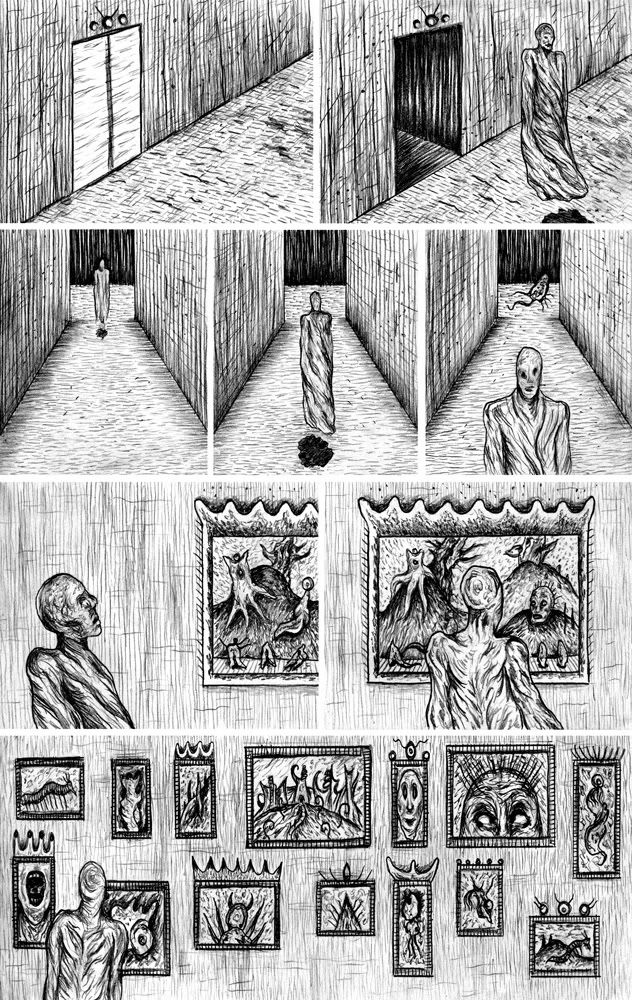
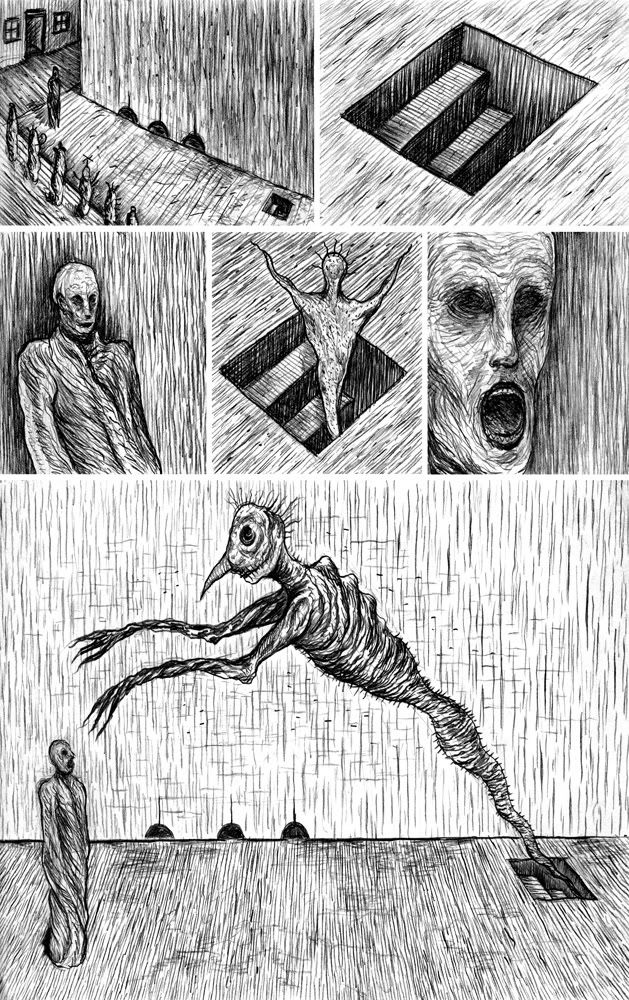
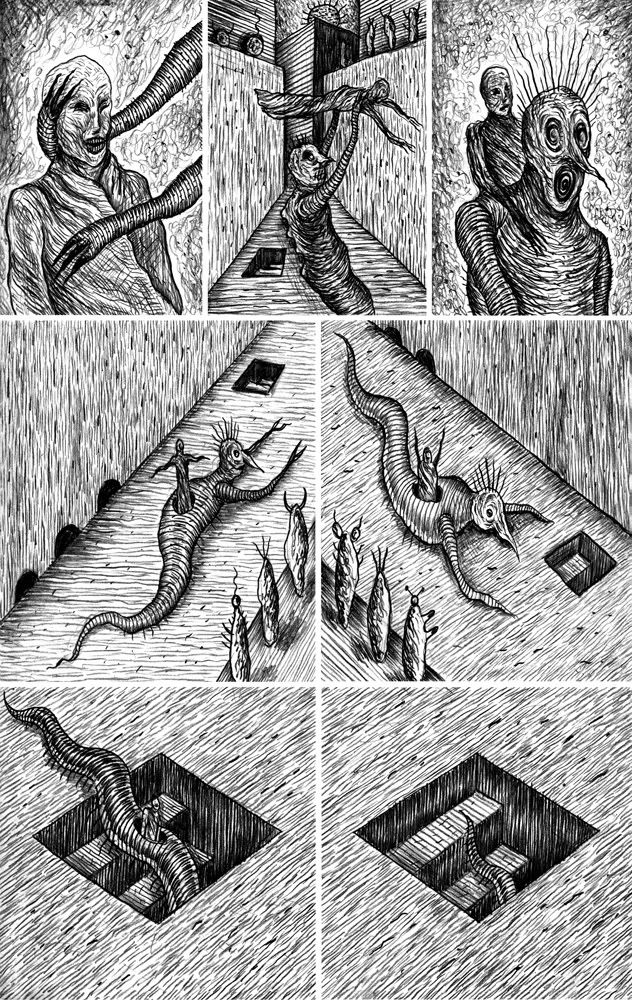
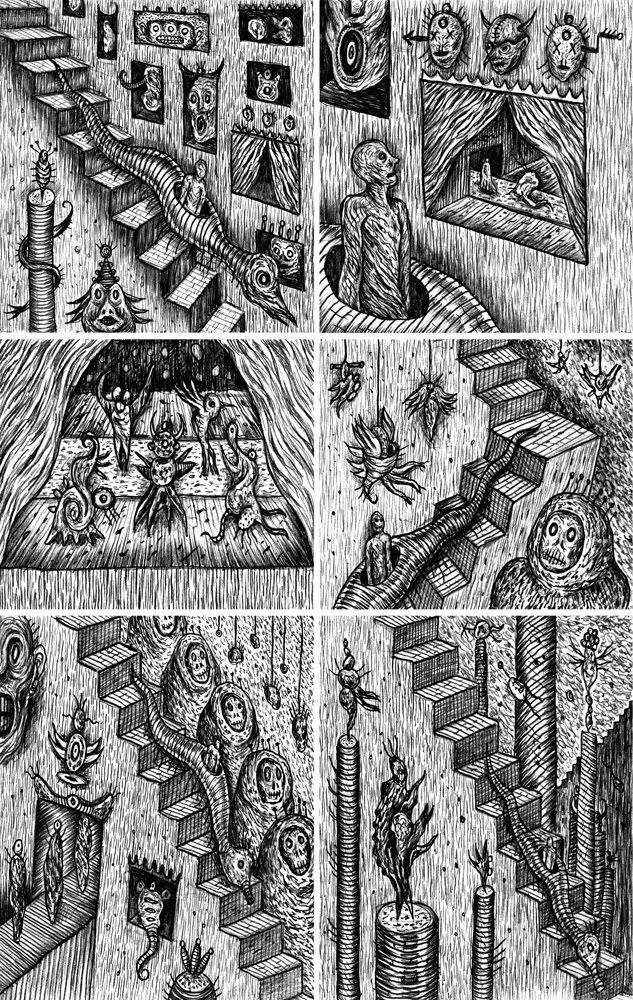
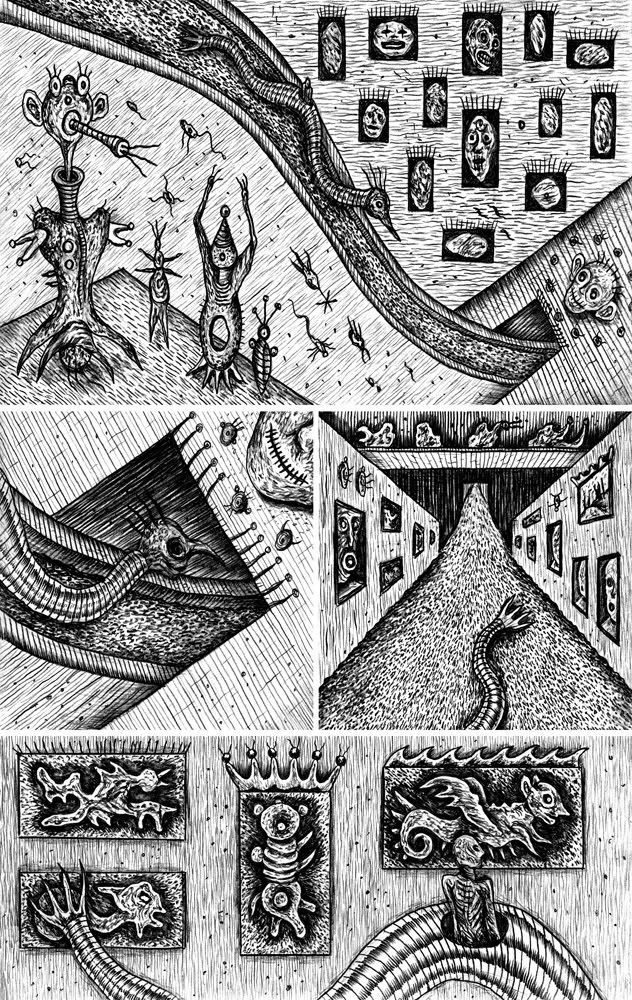
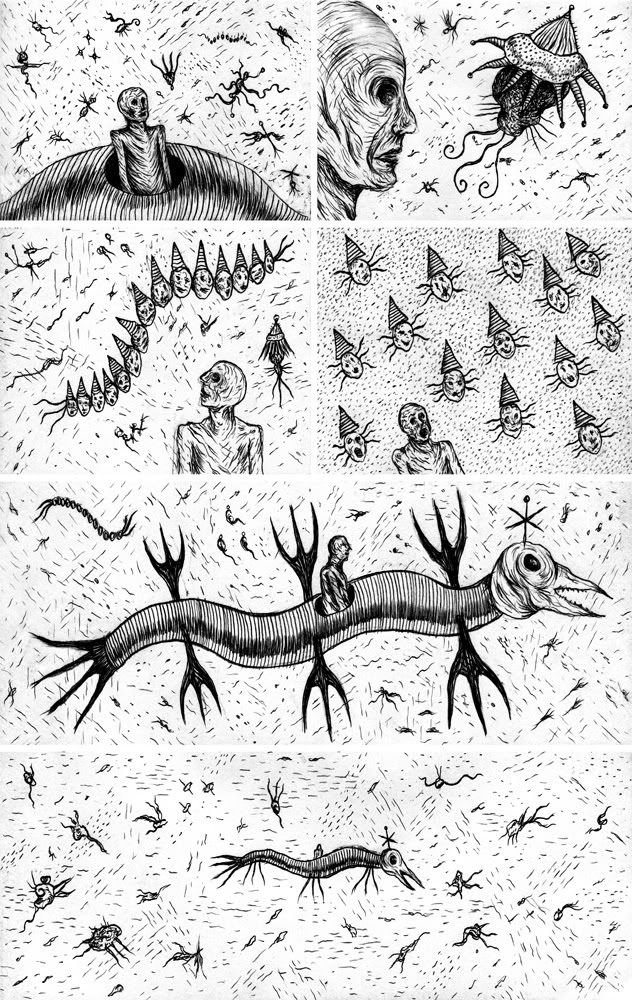
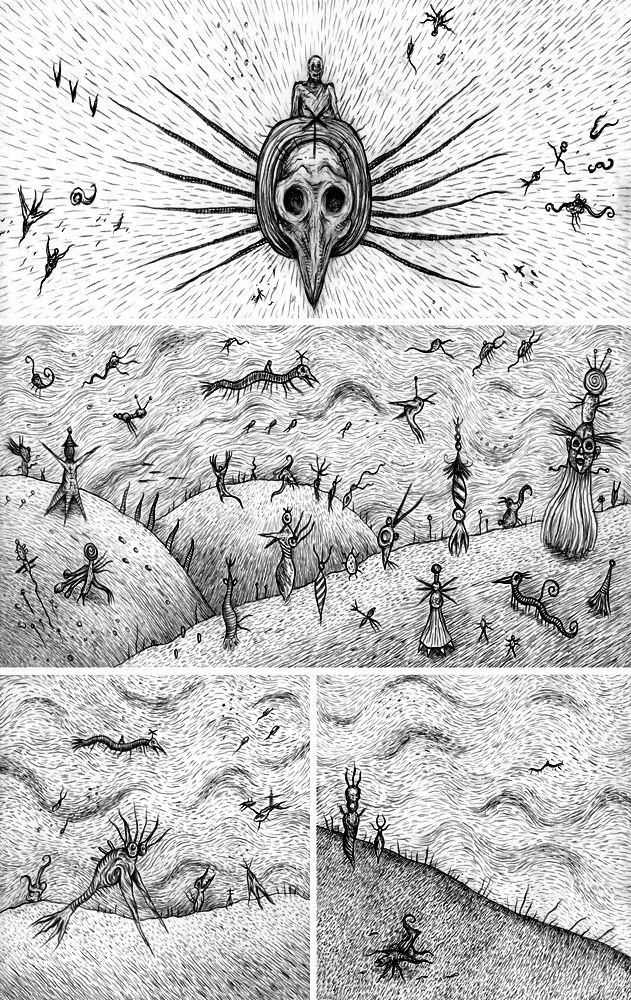
More Strange World - Pages 11 - 25 of 40


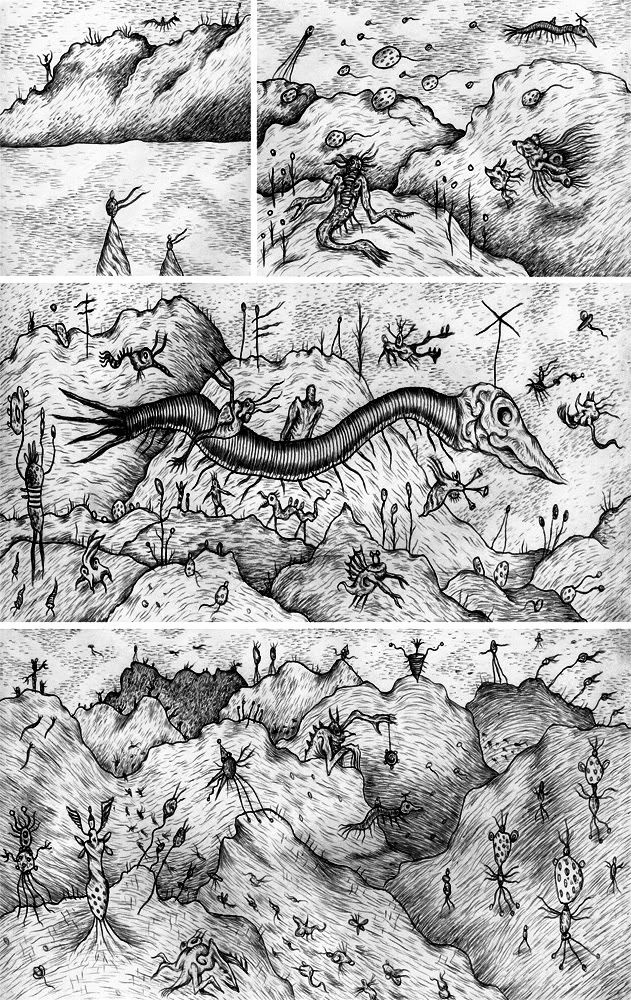
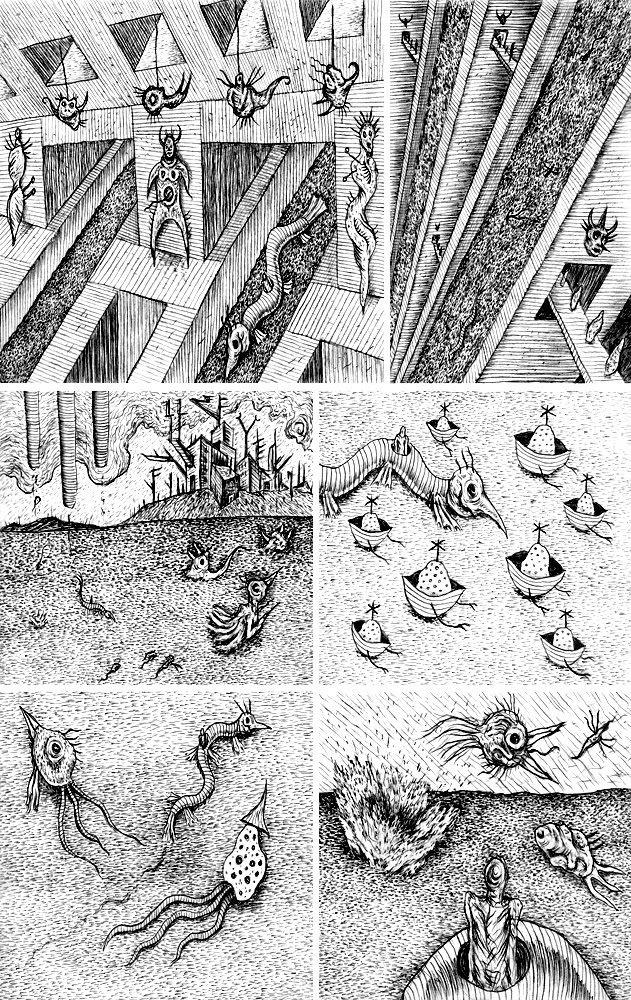
More pages from Strange World...

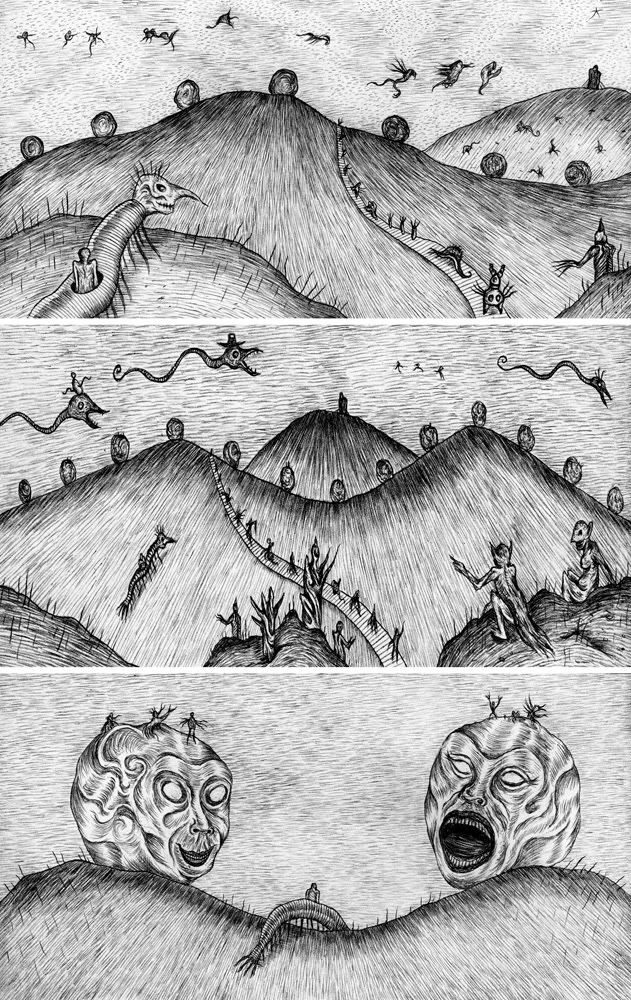
11 - 12 - 13 - 14 - 15 - 16 - 17 - 18 - 19 - 20 - 21 - 22 - 23 - 24 - 25

Wednesday, January 10, 2007

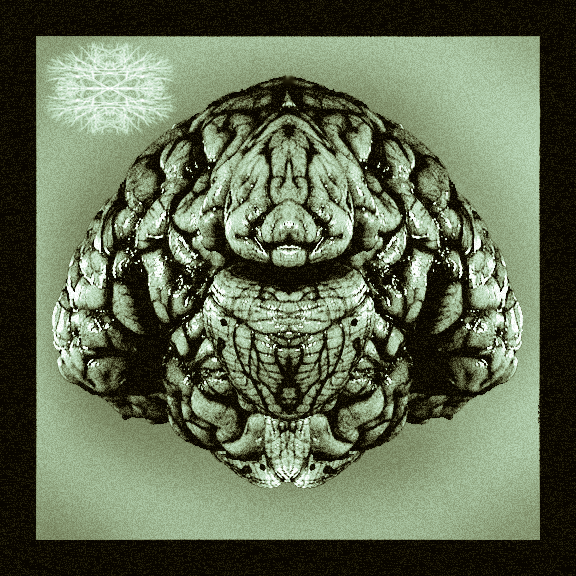
Alien Brain Album Cover--- LP


Ever feel like you're trapped in the early 1990's? I do.
If I ever have a chance at success in any commercial form, it will be a during some brief brain-fart period in popular culture when early 90s' "underground" crap is all the rage..
Like people will get into Skin Chamber, Godflesh and early Carcass for a summer..

Current playlist:

Nile- Black Seeds of Vengeance
Necrophagist- (all)
Portal- Seepia
Darkthrone- A Blaze in the Northern Sky
Cannibal Corpse- Tomb of the Mutilated
Matmos- all
Sub-Arachnid Space ( all)

Reading:

Choosing Death- A history of Death Metal and Grindcore ( Feral House)
Ode to Kirihito-Osamu Tezuka ( really weird)
The Graphic Works of Odilon Redon
Hino Horror #3- Onibobo and the Bugs from Hell
The Hounter of the Dark - John Coulthart
Sidney Sime- Master of Fantasy
Fearful Symetry- Northrop Frye
The Outsider- Colin Wilson

psychout


These are two attempts at psychedelic drawings done during summer 2004, I was inspired by Gary Panter's lightshow flyers.


Desk photo


This photo is of some tattered stickers that were originally on the inside of a cupboard door in my dad's magic shed. They were and still are very inspiring, I found out eventually that the two on the right are by the great Basil Wolverton, but I don't know who the left one is by, does anyone know?

My desk is just a regular wooden table, I like to have my stereo speakers on it, a good view of the tv and a light on the left.

Tuesday, January 09, 2007

Febrile Winter Incursion

I've figured out something that's sort of unfortunate, if I ever wish to become a 'proffesional' artist; I can't draw everyday. I draw much better when I force myself away from the table for a day or two, feeling like I'm building up steam with every hour away from the devil-board. Eventually, I jones for ink and brushes.It's the hours away from the table, where I don't know what to do with myself, questioning wether I should even bother with it all, when I come up with completely random works.
I did these last night. They are photographs that I manipulated very lightly on Photoshop. I'm not going to tell you what the photos are of, cause it'll ruin it.


-click to enlarge


-click to enlarge


-click to enlarge


from a different series..

-click to enlarge

Monday, January 08, 2007

Textbooks and Me

As sometimes happens, I am currently engaged in a pointless but entertaining pissing contest over at the TCJ message board. One of the things under discussion is textbooks, so I thought I'd reprint this essay I wrote about the subject here (it was originally on the Bridge Magazine website, but that seems to be either temporarily or permanently defunct.)

With Liberty and Report Cards for All

In a school…you are forced to read a hideous imposture called a school book, written by a man who cannot write: a book from which no human being can learn anything: a book which, though you may decipher it, you cannot in any fruitful sense read, though the enforced attempt will make you loathe the sight of a book all the rest of your life.
-- George Bernard Shaw, Parents and Children
In America today, the emotion most associated with children is not love or tenderness, but righteous indignation. Indeed, now that it’s no longer acceptable to refer to “our women” or “our darkies,” the phrase “our children” has become the preferred shibboleth of reformers, therapists, politicians, pundits, and other petty dictators. Anti-gun, anti-porn, anti-drug, pro-life — we may not have a chicken in every pot, but at least we’ve got a child on every poster.
Enter Diane Ravitch, education policy wonk in the Herbert Walker Bush and Clinton administrations. One day, Ravitch was going her happy, wonkish way, advocating national tests and excellence for all, when she had an epiphany: standardized tests, she realized, were fucking boring. Soon after, she discovered that textbooks weren’t any good either. She was, of course, shocked, shocked, and also appalled. As she herself noted, with touching naivete:
“Like others who are involved in education, be they parents or teachers or administrators or journalists or scholars, I had always assumed that textbooks were based on careful research and designed to help children learn something valuable. I thought that tests were designed to assess whether they had learned it.”
I don’t know about parents or teachers or “scholars,” but most students are perfectly aware that textbooks are stupid and that standardized tests are pointless. Ravitch does claim to have children of her own and was once, presumably, a child herself. Like many professional educators, however, she seems to have had those memories surgically removed.
Be that as it may, beneath Ravitch’s innocent veneer lurks a PR juggernaut. Reviewers have reacted to her latest book, The Language Police, with all the grim, self-satisfied enthusiasm of a school counselor diagnosing ADD. Ravitch boasts that she has yet to receive a negative notice, and she must be one of the few authors ever to earn accolades in both Mother Jones and The Wall Street Journal. This unanimity becomes more comprehensible once you realize that Ravitch’s book contains both numerous paeans to free speech and an ostentatious lack of bias, two qualities that appeal strongly to every journalist’s reptile hind-brain. Thus, The Language Police blames the failure of our schools on censorship, and goes on to argue that this censorship has been put in place by two of the most hated groups in our society — the politically correct left and the radical religious right. Meddling east coast do-gooders and ignorant southern Bible-thumpers have apparently formed an unholy alliance to scuttle plans for a rationalized curriculum.
As conspiracy theories go, this one is actually rather plausible. The far left and far right do have a strong negative influence on educational materials, with unfortunate, not to mention bizarre, results. It is in chronicling these that Ravitch is at her best. She explains how, in a national reading test on which she worked, a passage describing owls was rejected by a “sensitivity review panel” on the grounds that some Native American cultures view owls as taboo. A passage about dolphins was rejected because not all students live near oceans. The content of textbooks faces similar restrictions: Houghton Mifflin’s influential 1981 bias guidelines, for example, require writers to give equal representation to men with beards and men who are bald. And both textbooks and tests must avoid any mention of abortion, cockroaches, death, criminal behavior, evolution, politics, religion, etc. etc. etc. According to Ravitch, “Our nation prides itself on the principle of freedom of speech contained in the First Amendment…. Yet the practice of censorship…has been widely accepted for many years within the educational publishing industry as the normal way of doing business.”
Being outraged at this sort of thing is fun for everyone, and certainly the educational publishing industry routinely produces materials that combine the deft prose of appliance instruction manuals with the piercing analysis of a USA Today article. Still, fair is fair, and denouncing these companies for practicing censorship is ridiculous. Anybody who actually writes educational materials – as I do — knows that textbooks aren’t works of art. Nor are tests personal expressions of religious beliefs. They’re work-for-hire, like greeting cards or advertisements. Now, you can argue that forcing someone to read a greeting card for six hours a day is a monumentally inane thing to do. You can point out that making children memorize advertising copy is a fair definition of sadism. But you can’t very well cry “censorship!” because a greeting card is boring, nor can you blame the inanity of an advertisement on a violation of its creator’s Constitutional rights. As millions of Americans discover every time they turn on the Internet, free speech is not necessarily interesting or informative speech. Or, to put it another way, if given the opportunity to say whatever they want, people, and especially corporations, often choose to be vapid.
All of which is beside the point, since nobody actually believes in freedom of speech anyway. Certainly Ravitch doesn’t. As she puts it, “Clearly there must be some commonsense limitations on what people — especially schoolchildren — see and hear.” Ravitch’s caveats are more or less what you might expect: nothing “obviously pornographic,” no scenes of battle-torn bodies, no “sectarian readings,” no vicious racism or sexism. Ravitch justifies such strictures on the grounds of “good taste, judgment, and appropriateness,” and points to daily newspapers as a possible model for our educational materials. The suggestion that our nation’s famously ignorant, mercenary, and cowardly press should be touted as a blueprint for anyone or anything is worth a passing chuckle; even if journalists were in fact the paragons of disinterested wisdom that Ravitch seems to think they are, however, “commonsense” censorship is still censorship, precisely because one person’s “good taste” is another person’s abomination. Fundamentalists see much sex ed as pornographic; on the other hand, pacifists might argue that students should, in fact, be shown graphic images of what happens to the human body in wartime. The question, then, is not one of free speech vs. censorship, but of which career meddlers get to test their theories on the young folk — conservative yahoos like Jerry Falwell, liberal yahoos like bell hooks, or centrist government apparatchiks like Ravitch.
It should come as no surprise, therefore, that, despite Ravitch’s claim that she “trusts teachers,” she recommends tighter state and national learning standards, and more government-sponsored testing: all practices which would limit options and stifle creativity far more effectively than do crappy textbooks. Still, it is a little hard, given the frantic jerking of Ravitch’s right hand, to figure out exactly what it is she thinks she’s doing with her left. If free speech isn’t what she’s got there, then what exactly is at issue?
Ravitch seems ignorant of the answer herself, which has the inevitable effect of making her pronouncements somewhat muddled. Often she conveys nothing except a desire to have her bipartisan compromise and eat it, too — as when, for example, in the same paragraph, she demands that history texts condemn human rights violations and avoid moralism,. At other times she is handicapped by not having any idea what she is talking about, as in her blithering, knee-jerk attacks on all of popular culture; or in her belief that our segregated, stratified school system would become an engine of social equality if only students learned more about the Founding Fathers; or in her dewy-eyed assertion that the blandly inaccurate Eurocentric textbooks of yesteryear were somehow superior to the blandly inaccurate multi-cultural textbooks of today. Still, there are moments when Ravitch does rise to rhetoric, if not to a rationale. Check out, for example, the moving statement of faith below, complete with swelling strings and a slow dissolve to the flag:
“Not only does censorship diminish the intellectual vitality of the curriculum, it also erodes our commitment to a common culture. It demands that we abandon our belief in e pluribus unum, a diverse people who are continually becoming one. The common culture is not static; it evolves to reflect the people we are becoming. But even as it changes, it preserves the memory of ‘we the people’ in song and story; whatever our origins, we too become part of the American story, neither its first nor its last chapter. We are not strangers, and we do not begin our national life anew in every generation. Our nation has a history and a literature, to which we contribute. We must build on that common culture, not demolish it. As our common culture grows stronger, as we make it stronger, so too grows our recognition that we share a common destiny.”
Beneath the overwrought, overfamiliar stump-speech, Ravitch is laying her cards on the table. Education, it seems, is not, ultimately, for the good of the individual student, but for the good of the “common culture.” We make it stronger, not the reverse. And for what purpose are we spending our time propping up this strangely feeble culture? Why, to better appreciate our “common destiny” — a sunlit, democratic future, presumably, in which every American will have the right to answer multiple-choice questions about Silas Marner and feel good about it.
Ravitch, then, is a visionary: as she says sneeringly of the Puritans on right and left, she wants to create a “perfect world.” Unfortunately, like many utopians, Ravitch loves humanity but doesn’t care much for human beings — at least not when they’re under 18. Despite her emphasis on the unhampered interchange of ideas, it never seems to occur to her that a student might have something interesting to say. Thus, she scornfully dismisses the practice of including student essays in literature textbooks, since, of course, no student writing could possibly be as accomplished as that of, say, a hack writer of clumsy thrillers like James Fennimore Cooper. So much for high expectations. Even more invidious is Ravitch’s assumption that each student is an interchangeable, hollow vessel, into which the state must pour expert-approved content, lest the student instead be “molded by the commercial popular culture.” Thus, Ravitch solemnly intones, “A child who is suffering because of a death in the family is likely to gain more comfort from reading a poem by John Donne or Ben Jonson or Gerard Manley Hopkins than from reading banal teen fiction about a death in the family.” To which the only possible response is, says who? And furthermore, is it really the goal of our educational system to proscribe how a child responds to tragedy? Are we now going to start grading our students on how they grieve? If that’s not a totalitarian idea, I don’t know what is.
Schools are, of course, totalitarian places. Ravitch and teachers everywhere always talk about “opening doors,” but it doesn’t take an overly bright child to observe that the doors of the school building are shut. We claim we want students to be creative and intellectually curious, but when they draw graffiti designs in their notebooks, or write about drugs or sex or suicide in their literary magazines, they are compulsively censored and often punished. There is a contradiction at the heart of our educational system between teaching children what to think and teaching them to think. Are we providing students with skills to pursue their interests and think critically about their culture and their lives? Or are we trying to make them think the way we do — to make them into Christians, liberal humanists, or Hemingway enthusiasts? This is one instance where there is no “moderate” position — we can’t have it both ways. If we want our children to be intellectually free, we need better-paid, more qualified teachers who have the time and resources to treat students as individuals with differing interests, aptitudes, and opinions. And if we want our children to be obedient drones, then the least we can do is stop our hypocritical whining about “freedom of speech.” The only thing worse than being managed by a bureaucratic functionary is being managed by a bureaucratic functionary who claims to have your best interests at heart.

Strange World Pages 1 - 10 of 40


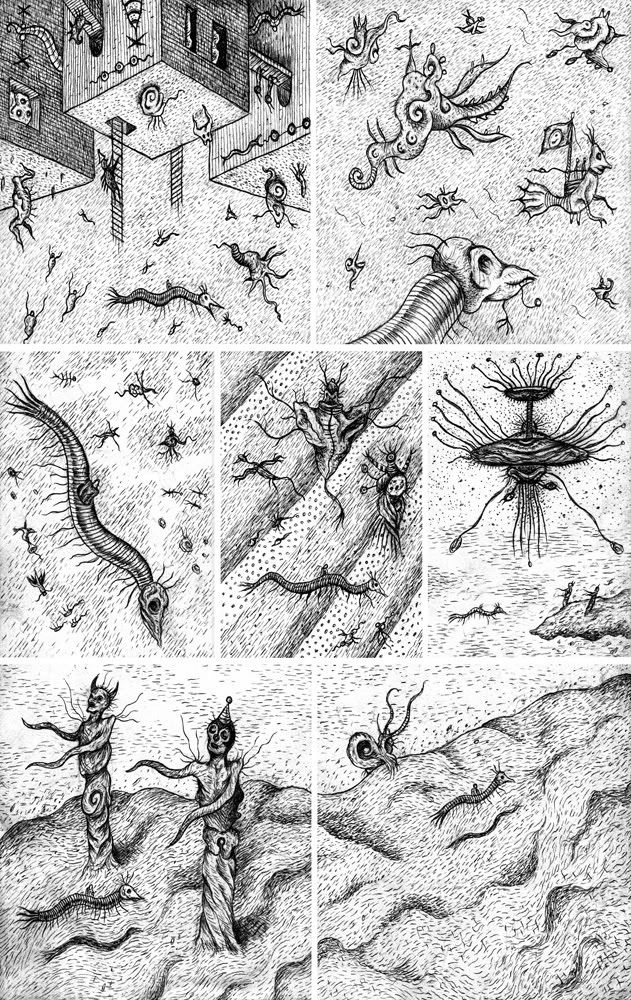
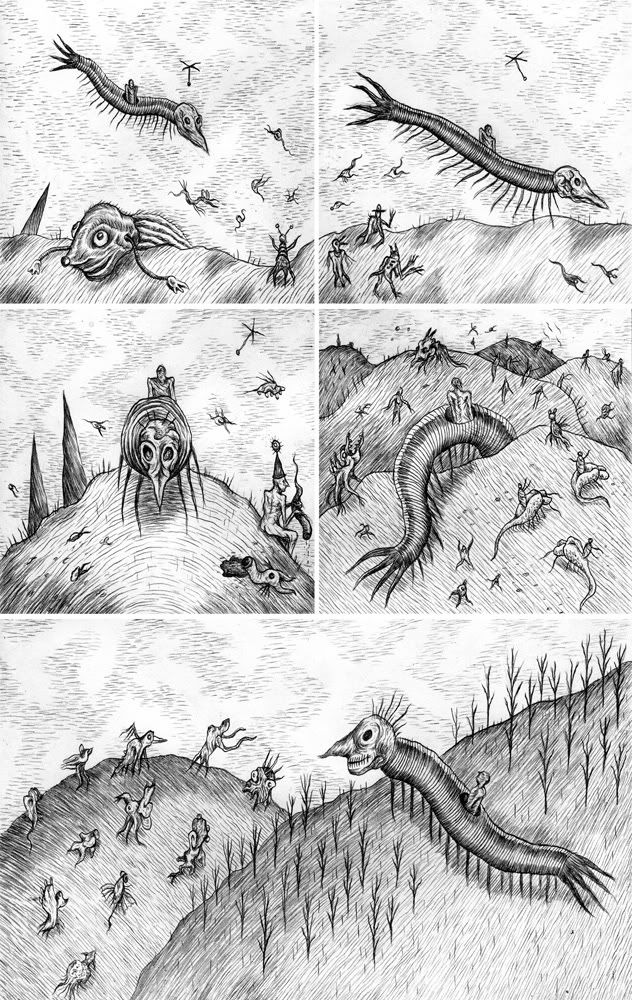
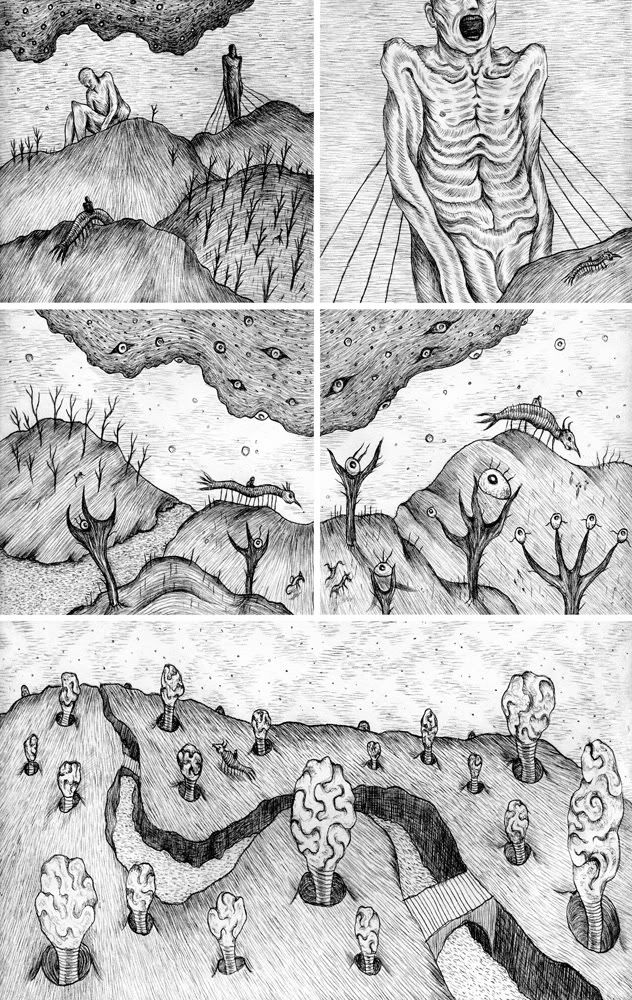
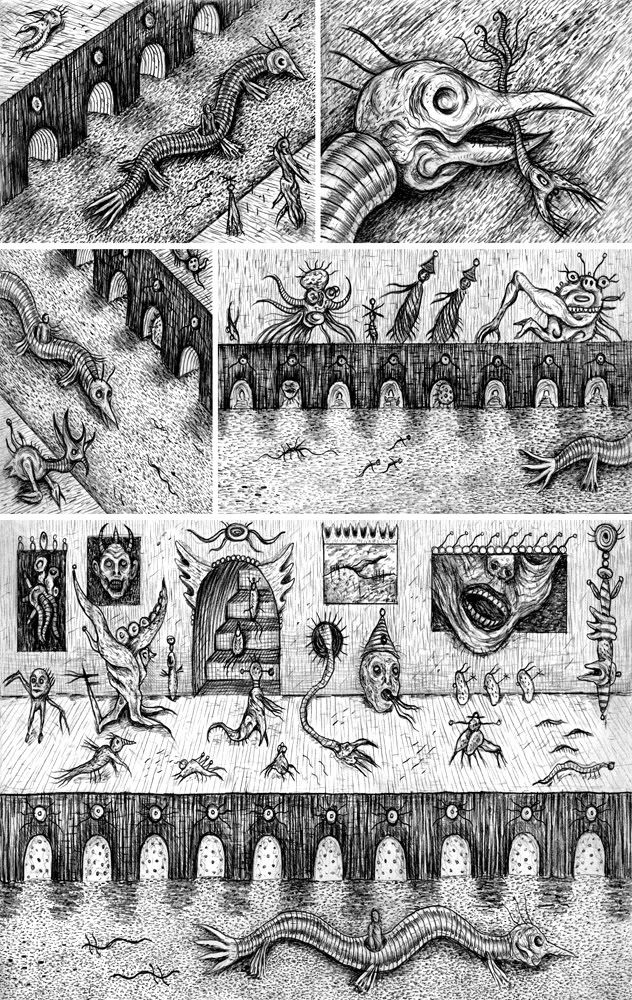
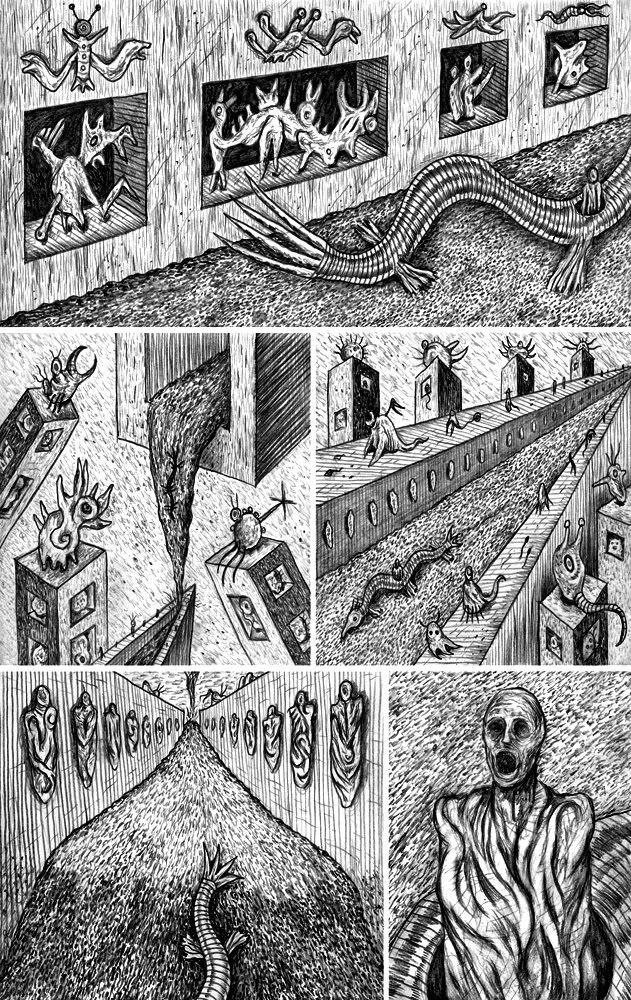
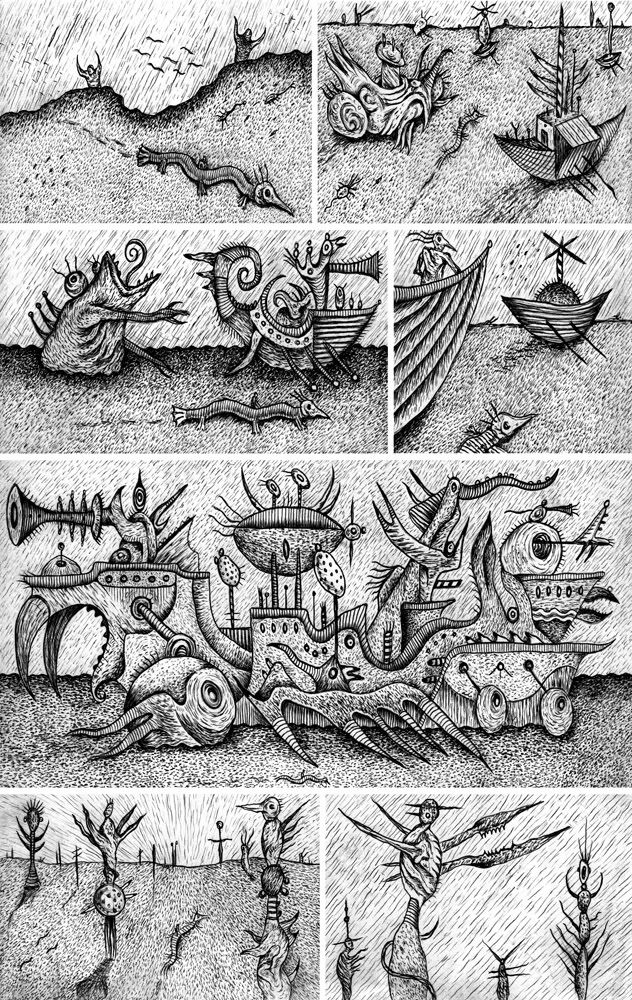
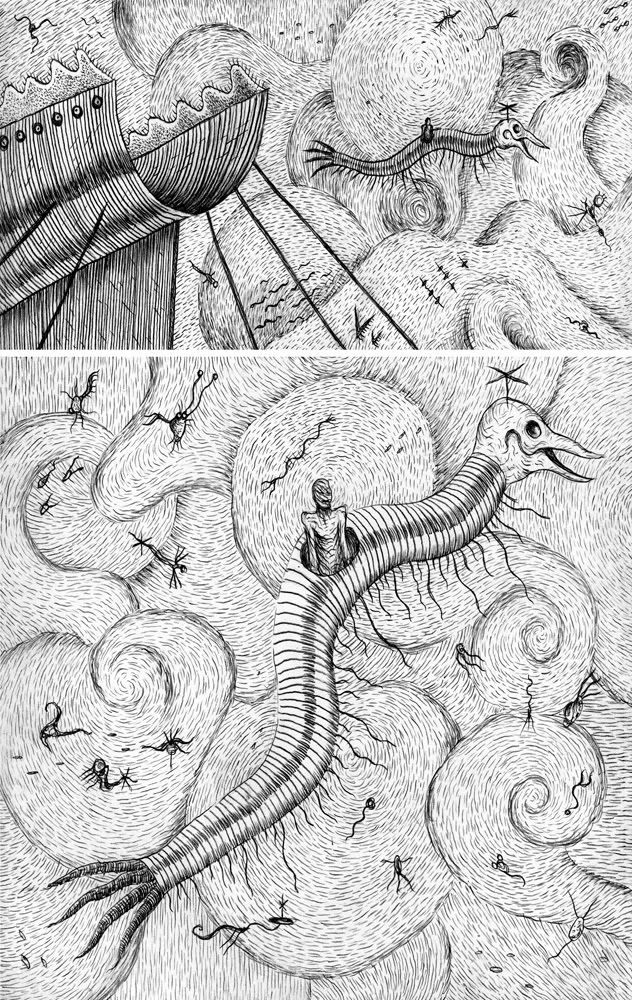
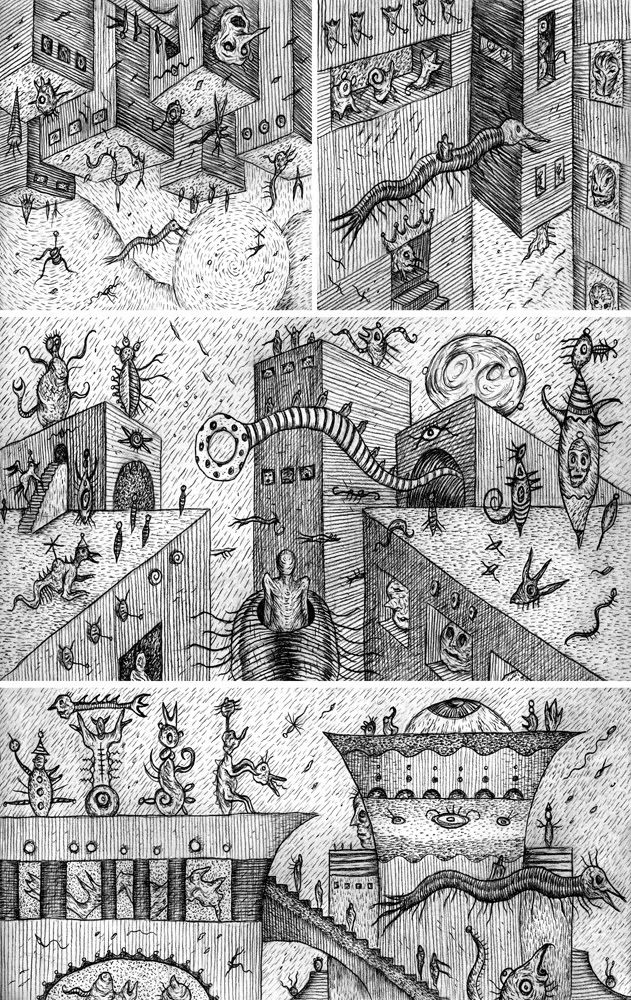
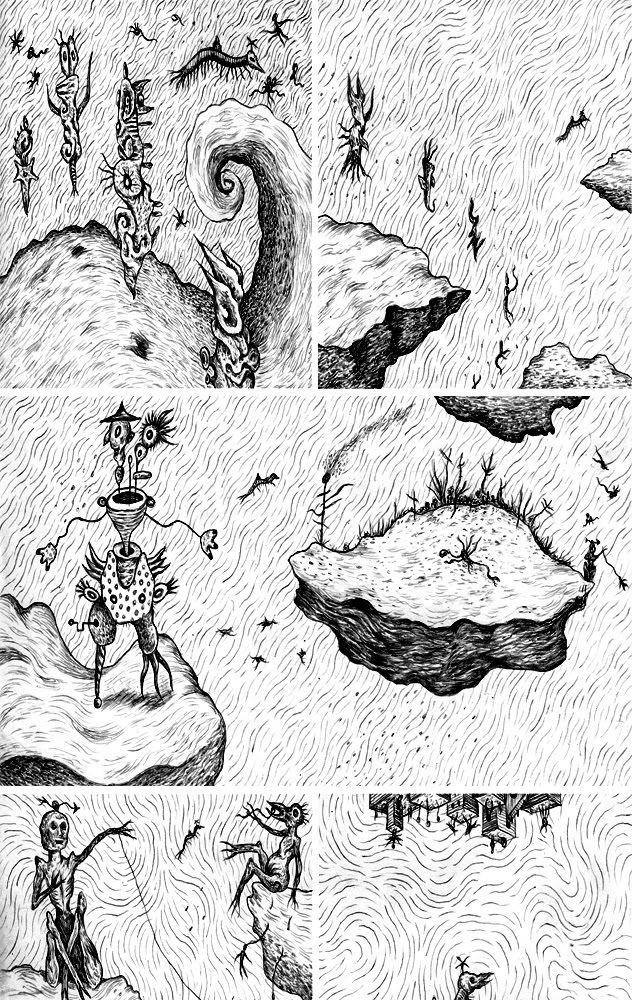
I don't have any immediate plans to print this thing so I might as well let it be seen online. Here's my first attempt at making a comic. It was more an experiment in exploring my drawn fantasy worlds then trying to conjure any kind of story. It's just a voyage through a weird dream world. The plot is simple, a man is taken by a weird beast that transforms into a centipede like thing. It goes underground and through a dungeon like passage and on into a Strange World. I'll post the rest of it over the next week or so, here's the first 10 pages.

Page One
Page Two
Page Three
Page Four
Page Five
Page Six
Page Seven
Page Eight
Page Nine
Page Ten

Sketchbook Doodle

OK, I'm back from a rather long pause after being away on a vacation and a period of sickness immediately following it. It's great to see there's been so much going on here!

Here's a recent page from my sketchbook.

Sunday, January 07, 2007

In the Shadow of No Talent (Noah)

This review of Art Spiegelman's "In the Shadow of No Towers" appeared in The Comics Journal #264 in November 2004. It generated some controversy on the TCJ message board, so I thought I'd put it online in case others were interested in reading it. (Hope Luke's not put out -- he was among those who hated it at the time, if I remember correctly!)

In the Shadow of No Talent

For me, as for millions of Americans, September 11, 2001 was no big deal. Nobody I knew was hurt, and the security restrictions caused me, at most minor inconvenience. There was a great deal of earnest discussion with acquaintances, much of it designed to demonstrate our supposed closeness to the attacks — this relative of a friend saw people jumping from the Trade Center, that friend of a relative worked in the Pentagon, and so on and so forth. All in all, the general mood seemed to be a not unpleasant compound of earnest sympathy and barely sublimated ghoulishness, as if the whole nation had slowed down on the highway to witness a particularly violent car crash.

Now, three years later, with the Presidential election looming, we’re all getting the chance to wallow in those emotions yet again. Pundits and politicians are falling over each other to remind us what it was like, really, on that day when America’s constantly regenerating hymen burst for, like, the twentieth time. Yes, there have been many more deadly disasters than the 9/11 attacks: for instance, the Iranian earthquakes last December (remember the Iranian earthquake last December?) But September 11 is nonetheless the most tragic tragedy of our times because it was more traumatic than any other…or maybe because it was more symbolic than any other…or maybe because it was on TV more than any other….or maybe because it was intentionally directed at wealthy white people…or maybe just because it was, dammit; what are you, some kind of Islamic extremist/commie?

The latest cultural artifact to go rummaging for meaning and runaway sales amidst the charred bones of the World Trade Center is cartoonist Art Spiegelman’s “In the Shadow of No Towers.” Spiegelman knows first-hand about the profitability of tragedy — his most famous book, Maus, was based on his father’s experiences in the Holocaust, and was an unexpected and enormous commercial success. That was twenty years ago, however. In the intervening time, Spiegelman has edited some anthologies, written a mediocre children’s book, drawn some New Yorker covers, and generally rested on his reputation as the man who made art comics a (potentially) mass market genre. “In the Shadow of No Towers,” then, is the man’s triumphant return both to the full length comic-book form and to the sustained interpretation of world-historical calamity. Released on September 7, it is well-poised to piggy-back on the inevitable hype surrounding the anniversary and the election. The publishers clearly hope that, like Maus, this will be not just a comic, but a media event — the high art doppelganger of Fahrenheit 9/11.

“In the Shadow of No Towers” has at least one built-in advantage over Michael Moore’s film — where Moore is merely a Midwestern interloper, Spiegelman lives blocks away from Ground Zero; he saw the second tower fall. If anyone could muster some sincere emotion about the events of September 11, therefore, you’d think it would be him. Certainly, “In the Shadow of No Towers” goes out of its way to suggest that its author has insights denied to the rest of us. Spiegelman seems to view himself as an Old Testament prophet, ignored and belittled as he bellows about the apocalypse. “Don’t they know the world is ending?” he asks in one comic; in another he laments that, “I insist the sky is falling, they roll their eyes and tell me it’s only my Post-Traumatic Stress Disorder.” In his introduction he marvels that when he went to a small town in Indiana, the people there were “at least as worked up over a frat house’s zoning violations as with threats from raghead terrorists.’” (Good thing Spiegelman hasn’t gone to the Sudan — I bet he would have found the indifference there to New York’s plight even more provoking.)

Yet, for all the wailing and gnashing of teeth, Spiegelman’s take on 9/11 is oddly uninvolving. Not that he hasn’t tried for catharsis. On the contrary, “In the Shadow of No Towers” is so eager in its pursuit of the aesthetic coup de grace that it becomes monotonous, like listening to a symphony composed entirely of crescendos. The format is itself a grand gesture: the comic is a series of ten broadsheet-sized pages reproduced on high quality cardboard, each packed with different drawing styles, strips running in different directions, panels dropped on top of other panels, stylistic changes, references to other comics, and heavy-handed allegory. The second page, for example, includes a series featuring Spiegelman chained to an American bald eagle, a picture of Spiegelman at his drawing board menaced by Osama Bin-Laden and an incredibly lame caricature of George Bush, a sequence about Spiegelman growing a beard and then shaving it off, a sequence about Spiegelman and his wife panicking in the first moments after the planes hit, and a final soliloquoy about the architectural limitations of the World Trade Center. Spiegelman (who claims that “issues of self-representation have left me slack-jawed”) represents himself variously as a cartoonish man, as a more realistic man, as one of the Katzenjammer kids from Rudolph Dirks’ vintage strip, and as a rodent. The last is apparently an effort to forcibly remind the reader of Spiegelman’s glory days — there’s no reason for it within the context of this project, but it’s how he drew himself throughout Maus

Convoluted, crowded designs can be used to convey turmoil, confusion, and despair, as they are, for example, in Hieronymous Bosch’s paintings. Spiegelman seems to be trying for a similar effect, without much success. In large part, his problem is simply that he doesn’t have the skills necessary to pull off his mighty effects. Virtually every aspect of the book is an aesthetic nonentity. Spiegelman’s thick pen lines, which were occasionally charming in Maus, deaden the grab-bag of styles he attempts here. His color palette swings back and forth from garish to drab almost at random. The layouts are cluttered, and rely, almost desperately, on over-obvious gimmickry to promote a sense of unity — on the final page, for example, the panels are organized into two columns; a lone airplane and some unconvincing flames in the background let us know that these are supposed to represent the towers of the World Trade Center. Worst of all, his borrowings from other cartoonists seem perversely bone-headed. In one sequence, for example, he references the Upside Downs of Little Lady Lovekins and Old Man Muffaroo, a strip by Gustave Verbeck which Spiegelman discusses in an afterward. Verbeck designed his comics so that, when you turned them over, each panel became a completely different picture. Spiegelman’s imitation, on the other hand, simply places two different images atop one another in each panel, the upper drawing oriented up, the bottom down. It’s a half-hearted effort, as if Spiegelman wants to get the credit for Verbeck’s deftness and ingenuity without putting in any of the work.

But even if Spiegelman were endowed with the combined visual imagination of Verbeck, Bosch, and Da Vinci , “In the Shadow of No Towers” would still be a failure. To write a good book — even a good comic-book — it’s important to have something to say. Spiegelman doesn’t. In Maus, Spiegelman managed to finesse this problem of content by cannibalizing his father’s experiences and storytelling flair. Here, though, Art’s on his own, and his struggles to fill up ten measly pages are frankly embarrassing. The central narrative, to the extent that there is one, involves Spiegelman’s reactions on the day itself. His daughter attended a school right next to the Trade Center, and Spiegelman and his wife rush to her. The three are reunited. End of episode.

This might form the subject of an amusing, low-key ‘zine by some happy-go-lucky slacker, but it hardly has the epic interpretive sweep we’ve come to expect from the great Art Spiegelman, an artist who claims portentously that “disaster is my muse.” Even Spiegelman seems to realize that, in this instance, the familial approach wasn’t quite working; according to the introduction, he scotched several more pages focusing on the tribulations of his daugter and son. Instead, Spiegelman resorts to padding. Huge panels are devoted to illustrating clichés (“waiting for the other shoe to drop” and “sticking your head in the sand.”) One entire broadsheet is devoted to his triumph in a battle of wits with a deranged homeless woman. Another half a page is devoted to his triumph in a battle of wits with a television interviewer. And then there are lots and lots of pictures of Spiegelman himself, bitching about the President, New York’s post 9/11air quality, and the fact that he draws so slowly that some Iraqis and G.I.’s will be killed before they can see his finished work — surely one of the most solipsisitic reasons for opposing the war on record. Spiegelman is also very upset by New York’s ban on smoking in bars.

Even with all these distractions, however, Spiegelman couldn’t quite grind out a book’s worth of material. Almost the second half of “In the Shadow of No Towers” is devoted to reprints of early full-page strips from the dawn of the medium. Spiegelman justifies this addition by explaining that, in the aftermath of the attacks, old comic-strips soothed his spirit. Poetry and music were too sublime and, he implies, hoity-toity to help him. Comics, on the other hand, were “vital, unpretentious ephemera from the optimistic dawn of the 20th century.”

It’s nice to see the old comics, and Spiegelman’s historical essay discussing them is by far the most informative and entertaining prose in the book. Nonetheless, his effort to incorporate this work into his own project is misleading. Spiegelman asks us to believe that since comics weren’t intended to last, they’re a good metaphor for the transient nature of everything, including big, honking office buildings. But who’s to say that these old artists thought their work would disappear? Winsor McCay and George Herriman were certainly less pretentious than Art Spiegelman, but that doesn’t necessarily mean that they believed their names would be utterly forgotten.

Even sillier is Spiegelman’s decision to pick old comics that, in his eyes, presciently comment on the events of 9/11. For instance, the Winsor McCay strip he reprints shows one character, grown to giant size, rampaging through New York, knocking buildings over like toy blocks. In one of Frederick Burr Opper’s Happy Hooligan comics, an irate camel knocks its clueless rider into, as Spiegelman exclaims, “a tower of acrobats!” A “Bringing Up Father” strip deals with the Leaning Tower of Pisa. Spiegelman says that each strip seems “like a political cartoon that could have been drawn within the past year or so…” But, in fact, none of them do. Most of these strips have no political content whatsoever. Those that do are set firmly in their own time periods, as is a Hogan’s Alley strip commenting on a then-controversial boundary dispute between Britain and Venezuela. In fact, it is the strips irrelevance that has earned them their place in the book. Spiegelman says (unoriginally enough) that the World Trade Center towers were “icons of a more innocent age,” and that seems to be how he views these comics as well. Now, with our greater wisdom, we can go back and see how such simple images foreshadowed a world of dread and terror. But back then, they were simple folk, who knew not what they did.

This is nonsense. The early twentieth century was no more innocent than the early twenty-first; in fact, the period from 1890 to 1920 was in many respects a low point in the United States’ moral history. Race relations — characterized by Jim Crow, lynchings, and a resurgent Klu Klux Klan —were, arguably, worse than they were under slavery. Unsurprisingly given the climate of the time, the comics Spiegelman has selected are full of disgraceful caricatures — what Spiegelman refers to fondly as “the gleeful racism of the day.” Even if you were white, though, it wasn’t a great time to be alive in America. Woodrow Wilson, elected in 1914, used the threat and eventually the actuality of war to restrict civil liberties on a scale that would give John Ashcroft wet dreams — as just one example, Robert Goldstein served ten years in prison for making a movie about the Revolutionary War because he had portrayed our World War I allies, the British, in a bad light.

You’d never know it from Spiegelman’s book, but some of the most eloquent protests against the injustice of the time were made by cartoonists. Artists like Robert Minor, Boardman Robinson, and Art Young are largely forgotten today, perhaps in part because they were socialists. Yet, their work is as meaningful now as it ever was — and no half-baked reinterpretation is required. One of Minor’s drawings, for example, shows an enormously muscled man with no head. He towers silently over an army medical officer, who rubs his hands in glee and enthuses, “At last a perfect soldier!” The contrast with Spiegelman’s work couldn’t be more stark. Minor’s picture is bare, almost frozen — the background is hardly sketched, so that all the viewer’s attention is focused on the recruit’s masterfully shaded torso, awaiting the order for violence. Equally arresting is a picture by Art Young of the Idiot Giant War, in which a blind, obese monster with a pronounced overbite muches casually on a bowl of human beings as if they were popcorn.

That cartoon can be found in Art Young’s Inferno, a brilliant description of some of the latest developments in Hell, circa 1934. The book is witty, wise, and chock full of illustrations which suggest Dr. Seuss in a really, really foul mood. Needless to say, it’s also long out of print. You’d think the comics intelligentsia might want to remember inspirational cartoonists like these, many of whom actually faced federal prosecution because of their work. But perhaps Spiegelman’s afraid that he’d look bad — after all, no one’s threatened to put him in jail, though I guess the New Yorker didn’t want to print some of these pages — awww.. No, it’s safer overall to pretend that our real troubles began on September 11, and cavort in safe, lucrative nostalgia. After all, weren’t things ever so much better when Clinton was in office and we were slowly starving the Iraqis rather than just shooting them outright? Weren’t we all happier when we were paying Osama to kill Russians? Wasn’t the world better off when the U.S. was run by competent imperialists like Woodrow Wilson and Ronald Reagan, rather than by the bumbling imperialists we have now? Feh. Or, as Art Young put it seventy years ago, “There are two major political parties in the section called the United States of Hell. Accurately defined, they are rival groups of office seekers and are voted for with the same kind of concern with which Hellions follow the races. As for logic, the difference between them is the difference between Tweedledumb and Tweedledumber, and both are loathsome and corrupt.”

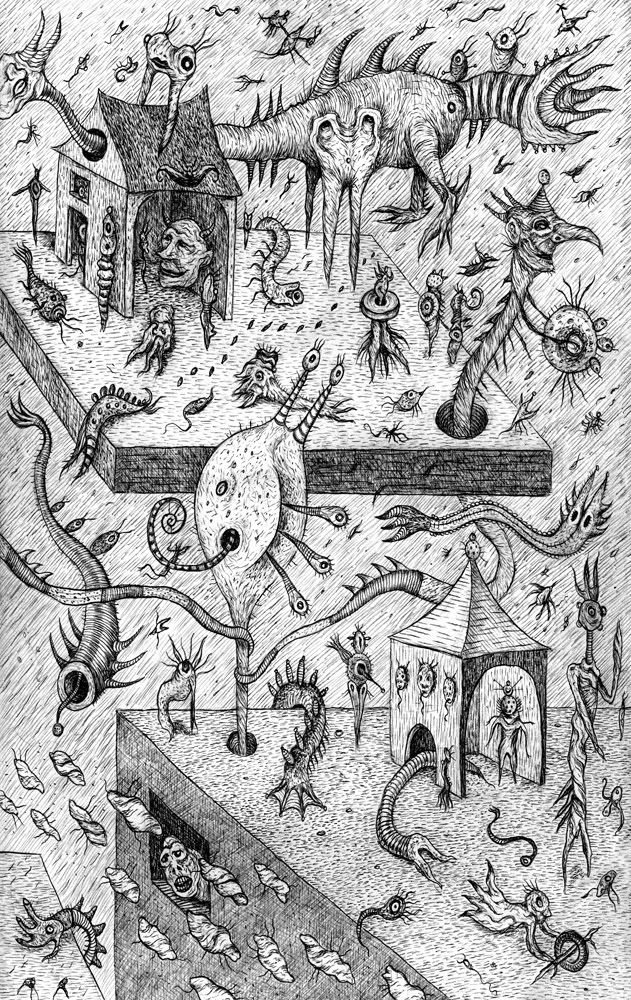
Ship of Fools


Just in case I don't use any of those characters I posted about before (for an ongoing comic) here they all are in one picture.