Showing posts with label lovecraft. Show all posts

Friday, February 28, 2020

Tropes versus Lovecraft - Part 4: A Pale Blue Dot

I’ve named this fourth trope (Part 1, 2, 3) of lovecraftian iconography „A Pale Blue Dot“, referencing the title of the famous book by Carl Sagan, as it draws heavily on the sense of isolation and fragility evoked by the image of planet Earth seen from space.
The internal mechanism of this trope is actually very similar to „Under the Surface“(UTS) and „Eye of the Beholder“(EOTB) in that scale, knowledge and perception are crucial factors in it. Obviously, when it comes to the scale difference between humans and the otherworldly entities in the images, here they it is pushed more or less to the limit. We don’t actually see any single human beings but of course we don’t need to, since Earth after all encompasses not only one or a group of individuals, but all of them. While we definitely know what situation humanity is in here, it’s not quite clear wether it itself remains ignorant of the threat (as in UTS) or is aware of it (as in EOTB). Even if it is, it will probably not be able to perceive it as clearly as we can in from our outer space vantage point.

To summarize, this trope and the two before it use very much the same elements to convey the basic lovecraftian philosophical worldview: human existence is threatened by outside cosmic forces next to which they are completely insignificant and which they can only perceive or understand to a very limited degree. Conceptually I think the ones where humans/humanity is not about to be eaten or willfully destroyed are more in line with this outlook because that undermines the entities’ indifference towards us.

I'll start off with one of my own drawings. It’s the cover for a HPL themed comic collection I put out for the CthulhuCon Portland in 2015. At the time I thought that it was a fairly original idea. Only afterwards I noticed other older versions of the same motif, and I 'm seeing newer ones popping up on a regular basis ever since.


Like with the other tropes, I'm not saying any of these are swipes (although some may very well be), I do however wonder if it shouldn’t be our goal not to replicate the same ideas again and again until they’ve lost all impact.
On the other hand I find it interesting how a quasi-religious iconography has emerged for Lovecraft’s (or Derleth’s if you will) Mythos, with all its spiritual/philosophical underpinnings. But that’s a topic for another day.

Here's another example of how a trope can become so overused that its ironic version is inevitable.


And a few fun bonus ones.


Final bonus! This is the final scene of the first Men In Black movie... seem familiar?


***

Tuesday, February 25, 2020

Tropes versus Lovecraft - Part 3: The Eye of the Beholder

Here’s my third trope of lovecraftian iconography (Part 1, Part 2), one that I have come across time and again. 


Virgil Finlay

I call it „The Eye of the Beholder“ (obviously not very original, but I couldn't think of anything better) and the Virgil Finlay illustration above is basically a subtler proto-version of the trope, while this great one by John Coulthart is more like the real deal:


John Coulthart

As with „Under the Surface“(UTS) the trope is not so much an interpretation of a specific scene from a given Mythos-story as it is an archetypical representation of the philosophical outlook typical to a Lovecraft story. In UTS, the pitiful ignoramuses above have no inkling of the real nature of their situation, the viewer is let in on the secret so to say, and can see the true horror of what lies underneath.
By contrast, here we are put into the situation of the puny figures in the foreground and are thus forced to identify with them, since like them we mostly do not see what it is that is staring at them (or us). Because we can see only its gigantic eye, a body part that is normally rather small in our view, we are forced to extrapolate the size of the being that is looking at us here. This has an effect similar to Lovecraft’s strategy of producing horror in his readers: Don’t show the monster - just give the audience enough info to set off their own imagination. Lovecraft himself does this in „The Shunned House“,  but instead of an eye the protagonist digs out a massive elbow in the basement of a haunted house, which, to be honest, always felt more comical than horrific to me. 
Another aspect that makes this trope effective is that a giant eye causes a twofold psychological reaction of both a visceral feeling of uncomfortable closeness and, perhaps more importantly, a recognition of sentience. I wonder wether the ending of „The Shunned House“ would have had more punch if there had been a giant eye which opened and glared at the narrator from out of that hole in the ground...

So here are some more examples. I've definitely seen others, but overall this one seems to be less common than „Under the Surface“.


Again, this post is not meant to critique any specific artist or piece of art. I don’t know most of the creators’ names but perhaps given the context of this post it’s perhaps not in their interest to be credited here anyhow. If any artist would like to be credited (or if they want their artwork removed) please let me know and I shall do so.


Friday, April 06, 2018

Die Ahnung - Zone 5300 Cover

Since I'm posting Lovecraft related stuff, I guess now is as good a time as any to post my recent cover artwork for the Dutch magazine  Zone 5300 (that Marcel is involved in). The issue featured also my Lovecraft-Kubin crossover short comic Die Ahnung (Premonition), which was originally part of the German-Austrian Lovecraft comic-anthology "Echo des Wahnsinns".


The little painting in the bottom right corner was actually done by Alfred Kubin in 1906.

Thursday, April 05, 2018

Tropes versus Lovecraft - Part 2: Under The Surface

Here's the second part in my series of posts on lovecaftian iconography (find Part 1 here).

At first I thought I'd call this trope  "Jaws" for obvious reasons, then I thought maybe "Der dankbare Ägir" because that's the oldest instance of this concept I've come across (although not connected to anything Lovecraftian; and I'm sure there are older ones).


In the end I stuck with "Under the Surface", simply because it not only describes the compositional principle but also the underlying metaphorical gist of it. I guess "Above & Below" or "Upstairs, Downstairs" would have worked as well.

As I've said in a comment to the last post, I'm not interested so much in depictions of the various Mythos creatures here or even similarities in images illustrating scenes from Lovecraft's tales. After all, it is not surprising that a certain character or scene from a given story would be often depicted in a similar way. These images don't strike me to be text-based illustrations but instead the intention seems to be to find a visual expression of a philosophical idea in a pop cultural framework.
Now, of course the problem of clichéd imagery doesn't only apply to Lovecraftiana, but in this genre it strikes me as particularly interesting, because of its quasi-religious (albeit atheistic) narrative. It's almost as if these tropes evolve like other religious iconography because they best represent a core emotional effect cosmic horror is supposed to have. Naturally, that effect is diminished by every new instance you see, not to mention the problems with visually representing something which is not supposed to be depicted - another aspect which the topic at hand shares with some religions.
But like in religious iconography the lacking impact of conceptual novelty is replaced or compensated for by a joy of recognition paired with the a reconjuring of the familiar ideological content. Think "Crucifixion", think "Pieta".
Well, perhaps this is all very trivial, and I'm sure there's a wealth of art historical texts about iconographic conventions and stereotypes in other fields, which go deeper into this matter than I ever could. I was just struck by the frequent recurrance of these images in my social networks and thought I should somehow collect them. I found none of these via google; they just popped up in my timeline and usually people thought they were great representations of a Lovecraftian perspective. Make of that what you will.


Finally, if the series of images above wasn't enough, I guess you can can tell a trope is a trope when it becomes ironic. This might very well be the final stage before becoming completely stale and meaningless.


***

As with the previous post, this is not meant to put any particular artist down, nor to critique any specific piece of art. I don’t know most of the creators’ names but I think given the context of this post it’s perhaps not in their interest to be credited here anyhow. If any artist would like to be credited (or if they want their artwork removed) please let me know and I shall do so.


READ PART THREE HERE.

Friday, March 30, 2018

Tropes versus Lovecraft - Part 1: The Prophet's Portrait

" A really serious weird story does not depend on a plot or incident at all, but puts all its emphasis on mood or atmosphere. What it sets out to be is simply a picture of a mood, and if it weaves the elements of suggestion with sufficient skill  it matters relatively little what fictitious elements the mood is based on. Of course the more obviously worn-out clichés (in method even more than subject-matter) had better be avoided — but a true master of atmosphere and suggestion can do wonders with even the commonest sort of theme. "

– H.P. Lovecraft


I’d like to try something else here on EBD, and post a series of artworks I’ve come across online, illustrating lovecraftian scenes or conveying lovecraftian concepts.
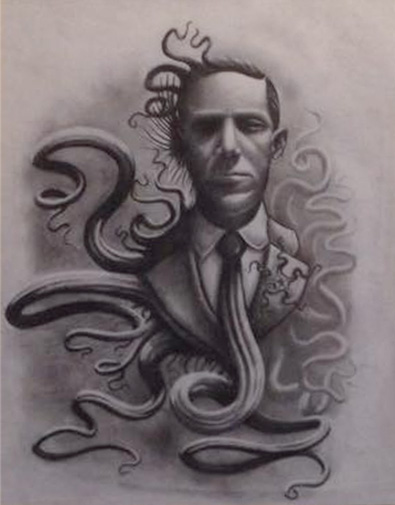
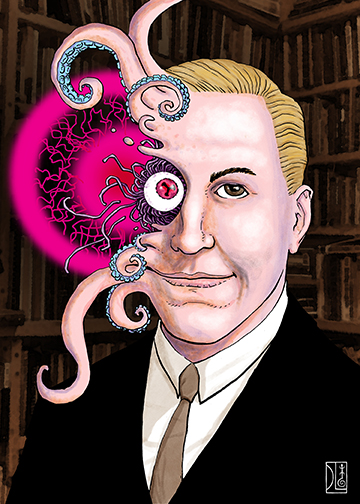
There are certain visual stereotypes in this genre which are consciously or unconsciously repeated over and over again, so I thought it would be interesting to categorize the various tropes and perhaps even develop some kind of pop cultural art critique concerning these types of illustrations. If it would lead to a higher degree of awareness that these tropes exist and maybe some pressure to develop new ideas, that would be a welcome side effect.

However, I’m not doing this to put any particular artist down, nor to critique any specific piece of art. Some of the examples are fan art, some are professional illustrations, and some are my own work. Many are obviously well-executed and probably in most instances the individual creators were thinking they had an original idea. Or perhaps they didn't and created theirs as a personal version of a common visual trope. Which, I guess, begs the question, wether there is something inherently "wrong" with this in the first place. In other epochs it was totally ok for artists to riff on other artists work, often to the extent that the visual concept became a shared cultural topos, to use a more neutral term, with no original artist's name connected to it.
Well, I have more things to say about this but I'll save them for the following posts. I would very much be interested to hear your thoughts.

So here's the first series of images. Where best to begin than with the many portraits of HPL himself. The stereotypical tentacles jump out pretty obviously, but seeing them juxtaposed like this, it also helps appreciate the instances where artists tried to give it a more individualistic style or inject a more original idea. Of the tropes that I have come across this is by far the most common. If you google "lovecraft portrait" you'll get most of these and countless very similar ones.
If this trope seems to obvious and boring to you I hope you'll find the following ones more interesting.


FuFu Frauenwahl

David Lee Ingersoll


I don’t know most of the creators’ names but I think given the context of this post it’s perhaps not in their interest to be credited here anyhow. If any artist would like to be credited (or if they want their artwork removed) please let me know and I shall do so.

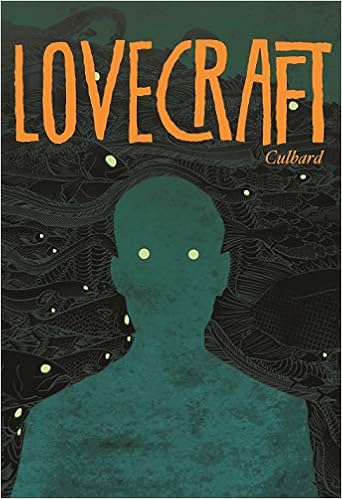
As a bonus I'll add Erik Krieks's beautiful cover illustration for his book "From Beyond", which cleverly takes the trope I've presented above and inverts it, kind of building on the fact that we've seen the stereotype so many times that we don't even need to see his face to recognize him.

Erik Kriek

Addendum: could Kriek's variation become a trope of its own?

https://images-na.ssl-images-amazon.com/images/I/51%2BGfqYWovL._SX340_BO1,204,203,200_.jpg
***