Wednesday, March 14, 2007

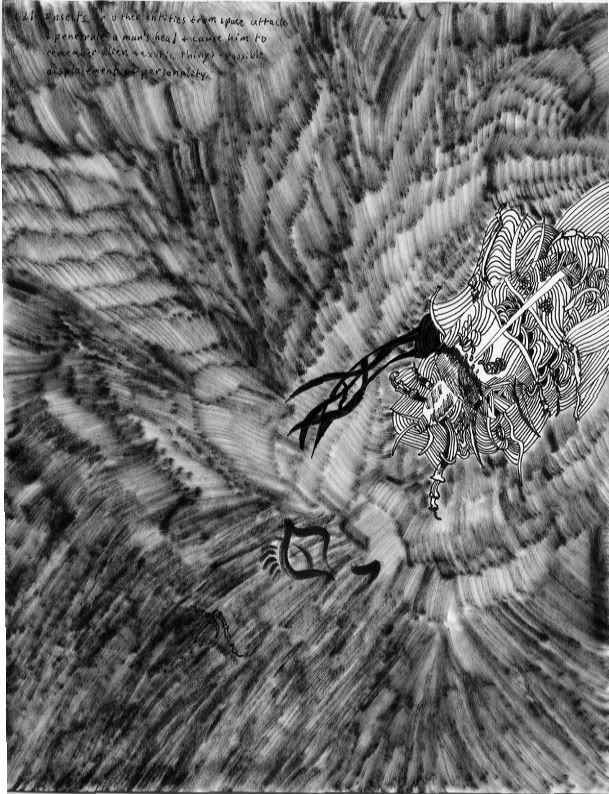
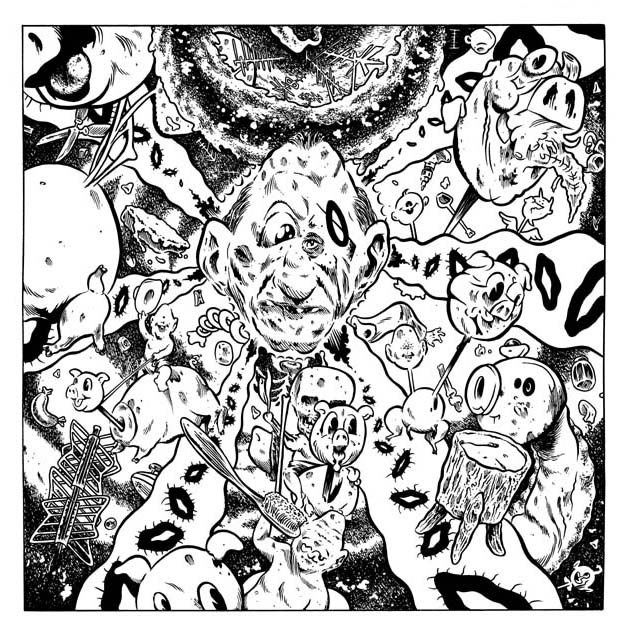
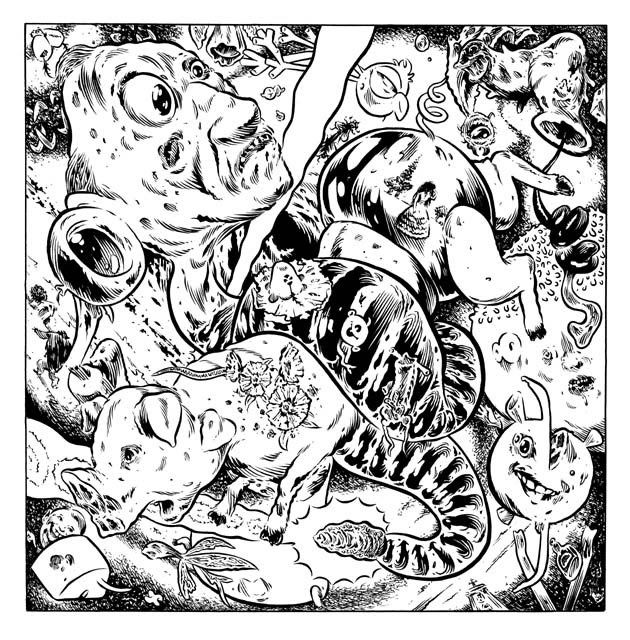
Rillifane Rallathil and Skoraeus Stonebones

Rillifane is god of the wood elves and "The Leaflord"; Stonebones is the stone giant god and "King of the Rock". So he's almost a Beastie Boy.

I was shocked when I finished this to see that I'd drawn a recognizable tree.


Text reads: "Sometimes 'stuck' really does mean 'stuck'. But the level of enthusiasm makes me suspicious."

Tuesday, March 13, 2007

Cuisinart Deco

The following is a submission for the Threadless <3's Bioshock tee design competition:


If it gets approved, I'm posting for votes. That's right. Need-based spam.

Sunday, March 11, 2007

Boredom on Infinite Earths

This essay was on the apparently defunct Bridge website for awhile; it came up in conversation on the TCJ message board, so I thought I'd reprint it here.

Boredom on Infinite Earths

“The cliques of artists and writers consist for the most part of a racket selling amusement to people who at all costs must be prevented from thinking themselves vulgar, and a conspiracy to call it not amusement but art.”
-- R. G. Colingwood

Since the passing of Charles Schulz in 2000, comicbook scripter Alan Moore has been the greatest English-language writer in the world.

I believe this statement is true, but it’s also somewhat beside the point. “Reputation,” as Moore points out in the recently reissued Writing for Comics, “is a trap that will turn you into a lifeless marble bust of yourself before you’re even dead.” This has probably been the case since the first sycophant shoved his nose in the unsuspecting (but alas, unprotesting) posterior orifice of the first artist and ruined the second cave painting. Things can, however, always get worse, and so they have. Time was when “arts and entertainment” weren’t mutually exclusive categories; when genre fiction was just, well, fiction; when acknowledged literary giants like G. K. Chesterton and Jack London could write nonsense verse and children’s literature; when poetry read less like this:

The shadowy cave we live in extends far out
Over the world. Plato said that. Even Amundsen
And all his dogs couldn’t find the end of it.
(From “Norwegian Grandson,” Robert Bly, 2003)

And more like this:

“Were all my body larded o’er
With darts of love, so thick
That you might find in every pore
A well-stuck standing prick,
Whilst yet my eyes alone were free,
My heart would never doubt,
In amorous rage and ecstasy,
To wish those eyes, to wish those eyes fucked out.”
(From “Mock Song,” Earl of Rochester, 1680)

These days, though, turning into a lifeless marble bust is not merely the result of a literary reputation, but its guarantor. How else explain the astonishing lionization of Ernest Hemingway, a man whose main achievement was to take the adventure out of boy’s adventure stories? Or the enthusiasm for Joyce Carol Oates, Queen of the Really Dull Gothic Romance? Or for Robert Hass, who, I understand, feels deeply? Or for John Ashberry, who, I understand, doesn’t? Or…well, you get the idea. Like the Kantian who knows he’s moral only because he’s miserable, we can identify a masterpiece of prose or poetry solely by its stolid dullness. It’s little wonder, then, that the most talented writers working today —Posdnuos of de la Soul, Judith Martin of “Miss Manners”, David Wilson of the Museum of Jurassic Technology— have chosen to seek fame and fortune outside the confines of literary fiction.

Which brings us back to Alan Moore and the much-maligned medium of comics. Moore is a hugely popular and respected figure, but it is still a little strange to hear him warn of the dangers of reputation, and even more so to hear him inveigh against “Reputation’s immortal big brother, Posterity.” Posterity? For comics creators? Comics may be inexplicably accepted as art in benighted locales like Japan, but in the U.S.A. comics have been viewed by most commentators as colorful cud for the barely literate. Maus-creator Art Spiegelman has stated that he used to be so embarrassed to be seen reading comics that he would hide them in copies of Playboy.

Dangling reputation in front of a cartoonist, in other words, is a bit like waving red meat in front of a starving Chihuahua. And as the professional arbiters of respect have begun to toss one or two scraps towards comics creators, the latter have responded with a frantic and joyful yapping, cheerfully urinating all over their predecessors in order to mark out the fragrant boundaries of their new literary reputations. Chris Ware, for example, has been hailed as a genius for sensitively suggesting that people who read superhero comics are intellectual, emotional, and sexual cripples. Similarly, in his 1991 New Comics Anthology, Bob Callahan sneered, “Prior to this point in history, comic strips were created by often exceptionally talented men and women as a way of entertaining nitwits and kids.” Self-respecting artists, apparently, aim their products only at the crème-de-la-crème: the wise, the thoughtful, and perhaps the occasional literature professor. If Shakespeare wrote for the uneducated rabble and Mark Twain wasted his days on books for boys -- well, what of it? That was a long time ago, and we’d know what to do with them if they tried that sort of thing around here. You don’t catch Cormac McCarthy attempting to amuse high-school dropouts, do you? Does Mark Strand write children’s verse? No and no -- the literati are for the literati, and as for the rest, let them eat Stephen King. In the meantime, the comics medium, after 60-odd years of over-muscled goombahs and talking cats, is finally ready to bore the pants off innumerable school-children. Dan Clowes, like John Updike, really understand the Souls of Women. Joe Sacco, like Susan Sontag, has visited Serbia. Sincere meaningfulness is in the air, progenitors are being slain, and lavish praise from Harold Bloom cannot be far behind.

Of course, the New Comics gang doesn’t think that it is trampling on the best traditions of the medium. On the contrary, it claims to be upholding comics history; to be pointing out, amidst acres and acres of market-soiled virtue, the few unblemished hymens of artistic vision. Art Spiegelman has been particularly good at this sort of thing, publicly and fulsomely lauding the genius of George Herriman’s Krazy Kat, Harvey Kurtzman’s Mad, and — in a massively over-designed coffee-table book— Jack Cole’s Plastic Man.

What Spiegelman doesn’t seem to have quite realized is that his own shockingly conventional musings (“Maybe everyone has to feel guilty. Everyone! Forever!”) and clumsy co-option of comics history (The Holocaust…but with mice! It’s high art! It’s low art! Genius!) bear no resemblance to the work of his purported heroes. Indeed, the pulp crap Spiegelman despises — the issue of Flash in which our hero’s head grows to the size of a watermelon, for example, or the man-eating Christmas elves with ears for armpits in Eric Powell’s The Goon — are much more in ye olde tradition than anything Spiegelman has done. The thing about Herriman or Kurtzman or Cole is that, basically, they’re a blast. Hyper-active plots, surreal transformations, energy, surprise, a pursuit of the preposterous which never feels like slumming, a deliberate flirtation with self-parody, and endless, endless creativity: these guys, whatever their process, always made it look easy — they had the elan of trapeze artists, effortlessly spectacular and light as air. Does any of that describe Maus? No. Bowed under the burden of his press clippings, solemnly staggering from Holocaust to September 11 like some high-concept ambulance chaser, Spiegelman wants you to see him sweat. How else would you know that he’s a serious auteur? And so we’re treated to scenes of the Cartoonist at Work: panel after panel in which he suggests that his ambivalence about celebrity is somehow made more poignant by Auschwitz, or vice versa.

The arbiters of culture would, like Spiegelman, have us believe that canonization is the highest goal to which an artist can aspire. They fail to see — or, perhaps, see all too clearly — that when an artist enters the canon, he or she ceases to be an artist, and becomes instead a promotional device whereby the elites sell themselves to themselves. Da Vinci, Emily Dickinson, James Joyce — they don’t have audiences anymore, they have worshippers. Once, maybe, they had some ambition to entertain and enlighten their fellows, but now their most revered message is the totemic power of their names, repeated over and over, like television advertisements in a dead language. Indeed, the deadness of the language becomes the point. It is the canonical work’s very inaccessibility and irrelevance which gives it its fetishistic power, and so the initiates dedicate themselves to creating mysteries where none exist. Sacred passwords such as “artistic integrity,” and “enduring human concerns” identify believer to believer, and they smile as they gather in their faculty lounges and gourmet coffee emporiums, confident that their incantations will hold off the sea of drooling peasants which might otherwise engulf them. And for bonus points, why not complain about how oppressed you are by the philistinism of the people who bind your books, clean up your spilled cappuccino, and wipe your fucking ass?

If when you hear “art” you think “lifestyle accessory”, you would have liked the Comix Chicago exhibit at the Hyde Park Arts Center in September 2003. Though the ostensible theme of this show was “Comics About Chicago,” a more accurate description might be “Comics In A Really Important Art Gallery.” No super-heroes here, no sir. Also, no flights of fancy, enthusiasm, childishness, or any idea that would raise the hackles of a tenured radical. Many of the traits that have historically made comics great are incongruously in place, but they’re all viewed through a kind of inverse funhouse mirror, which makes the bizarre and outrageous appear mercilessly bland. So Dan Clowes dabbles in a surrealism stripped of drive and panache. David Heatley borrows Winsor McCay’s idea of dream comics, tosses out the magical juxtapositions and improbable adventure, and gives us Curator, a careerist fantasy in which Heatley pictures himself as a feted art star. Jessica Abel takes the addictive narrative melodrama of Stan Lee, adds a heaping glob of earnestness, and ends up sounding like a bad high school literary magazine. (One of her characters actually says, “I love this record. It makes me ache. It feels like the future.”) And Archer Prewitt makes slapstick okay for the bourgeois by replacing imagination and general goofiness with a smug sneer that says, “We’re all superior to these hi-jinks, aren’t we?” At least Prewitt’s characters, like those of his predecessors, still speak in the bastard Negro dialect of the blackface minstrel. Thank God that, in this age of political correctness, it’s still okay for white art school graduates to laugh at po’ black folks.

You’d think that, even if the writing were a wash, an art gallery would pick comics with a certain level of visual interest. You’d be wrong, though; the art, like the text, is frankly pedestrian. The best drawing in the show is little more than competent; nor does anyone represented here have the flair for cartooning that translates into a recognizable and distinctive style. Forget about Dr. Seuss — we’re not even up to Gary Larson’s standards here. The collage which adorns the reverse side of the show’s promotional poster is, in this regard, particularly damning. Someone chose panels from each artist and mixed them together in a loosely sequential arrangement, presumably to highlight the diversity of skills on display. Instead, all the pieces just melts into one big, drab blur, the artists undifferentiated from one another by either subject matter or talent. In the show itself, there are a couple of pleasant moments; Dan Clowes’ “Nature Boy,” has a nice, filmic movement, and the colors and composition of Deadpan #1 by David Heatley (an acquaintance of mine) are lovely. Even if you throw in a couple of cute cat drawings by Ivan Brunetti, though, that’s pretty slim pickings, especially when balanced against Erik Wenzel, who seems to be laboring under the misapprehension that taking multiple photographs of the same boring cartoon is…what? Vaguely amusing? A half-hearted David Letterman routine?

The big, fat exception to all of this is, of course, Chris Ware. Everybody says Ware is the greatest comic artist of his generation, and it’s pretty hard to argue — his hand-lettered calligraphy alone is reason enough to come out to Comix Chicago. It’s Ware’s compositions, though, that are really sui generis. Nobody but nobody thinks about page layout the way that Chris Ware thinks about page layout. Most artists — especially American artists of recent vintage — tend to design comics pages sequentially; whether you’re reading R. Crumb or Stan Lee, you start more or less at the top left, end more or less at the bottom right, and walk away with a narrative. Chris Ware does this too, sometimes, but he’s just as likely to organize the page around a single drawing of a giant house or machine, or as a gameboard, or as an interlocking series of smaller and larger strips oriented in various directions. The result is breathtaking, especially on something like the Jimmy Corrigan book jacket, where the details spiral down into infinitesimal complexity, arrows point every which way, and you can spend hours just trying to figure out which way is up. And, as if that weren’t enough, Ware also happens to be a fantastic writer, with a style somewhere between Beckett, Schulz, and the language of ’50s marketing. In the “Whitney Prevaricator,” for example, the great men of Western art wander through Ware’s tiny panels like heavily sedated office workers searching for the right cubicle. I think my favorite moment is when an eager Renaissance man-in-training starts spouting lines out of True Romance: “That Goethe, he’s a famous humanist! I’ve got to do something to impress him!”

Which only makes it more depressing to view the aesthetic atrocity that is “Ruin Your Life: Draw Cartoons.” You might think that with television reality shows our society had pretty much sunk as low as it was possible to sink in terms of dishonesty, pandering, and sham self-revelation. But no; Chris Ware has dragged his massive talent to cultural bottom, and he has begun to dig. Everything that’s delightful about the “Whitney Prevaricator” — most noticeably the sense of social realities which makes satire possible — has here gone horribly awry. The “Prevaricator” mocks the anguish of artists as being idiotic and overblown. “Ruin Your Life,” on the other hand, is devoted to the proposition that life is just really, really hard for alternative comics creators in general, and for Chris Ware in particular.

Now, you might think that things were going all right for Ware professionally. He’s been in the Whitney Biennial. He recently became the first comic artist to win a major British literary award. He’s been positively reviewed in People, for Christ’s sake, and he gets to make his living as a cartoonist rather than as, say, a coal miner. But as a college-educated white boy with skills, Ware knows that he is just not getting his due until all of us awaken each morning and genuflect towards his drafting board. And so he feels sorry for himself. Working in comics, apparently, will doom you to “decades of grinding isolation, solipsism and utter social disregard.” (Silly me; I thought that was working at McDonalds — or being unemployed.) Comics are also “inextricably linked to adolescence and puerile power fantasies,” and “If anyone finds you the least bit attractive, you are not a cartoonist.” Comics artists waste their youth in grinding toil, chained to a “reviled pictographic language” which is nevertheless much more demanding and unforgiving than the mere written word . (If only Kafka had known how easy he had it— maybe he would actually have finished one of his novels!)

Of course, like Ware, the intellectual art-viewers who file past his work know the pain of being under-appreciated; the loneliness that comes from sitting almost, but not quite, at the top of the heap; the struggle that results when all your needs are met and you realize that you’re still mildly disturbed by the hideous rending noises as your domestic servants are tortured outside your studio. If you listen carefully in the gallery, you can almost hear the forlorn souls of the privileged crying, “We find you attractive, Chris!” as they make his self-pity their own. And if they don’t get enough there, they can always walk across the room and absorb Ivan Brunetti’s “Cartooning Will Destroy You,” in which Brunetti moans that “no one even gives a shit about comics,” and wonders if instead of cartooning it would be more moral for him to be “mopping the AIDS ward at a county hospital.” Perhaps he’s hoping for sympathy from the terminally ill. After all, “It’s a lonely business, sitting day in and day out alone…writing and drawing books that have little hope of reaching an audience beyond other comics artists….” Quick, who wrote that, Brunetti or Ware? Okay, you caught me; it’s actually from an essay in the promotional booklet. Comics have, at long last, reached that marketing nirvana where art and puff piece are one.
The irony is that alternative comics are supposed to be more personal, or at minimum more idiosyncratic, than their mainstream brethren. Yet Ware and Brunetti, who focus on themselves obsessively, have written comics which are thematically indistinguishable. Meanwhile, in Alan Moore’s Tom Strong, the title hero discovers an alternate timeline in which he is black and in which, perhaps as a result, everybody on earth is happier. The role of race in the story is complicated by the fact that the white Tom Strong has a black wife and daughter (regular characters in the series) and, of course, by comics’ disgraceful history of caricaturing and ignoring minorities. The impact is somewhere between that of Chester Himes’ detective fiction and the Fu Manchu novels: a straightforward adventure story given a queasy resonance by social and political implications which are suggested but never quite worked out. The story isn’t great, necessarily, and it isn’t Moore’s best. But it’s individual and it’s thoughtful, which is more than can be said for the maudlin navel gazing of Jeff Brown — or, wait, I mean Ivan Brunetti.

I’m not saying that all mainstream titles are necessarily better than alternative ones: for the record, they’re not. But I am saying that dismissing qualities supposedly associated with mainstream super-hero comics —popularity, silliness, a desire to entertain — is the surest way to take a young, adventurous medium bursting with potential and transform it into an ossified piece of crap. Art may be about communication, it may be about truth, and it may be about beauty, but it sure as hell is not about impressing a grant committee. If you’re not willing to look ridiculous, be an accountant or something. An artist who wants to be taken seriously is an artist who needs a swift kick in the pants. And if comics aren’t respected by everyone in the academy or in the hip hang-outs — well, frankly, good. As Alan Moore notes, “The only thing that might seriously endanger either your talent or your relationship with your talent is if you suddenly found yourself fashionable.”
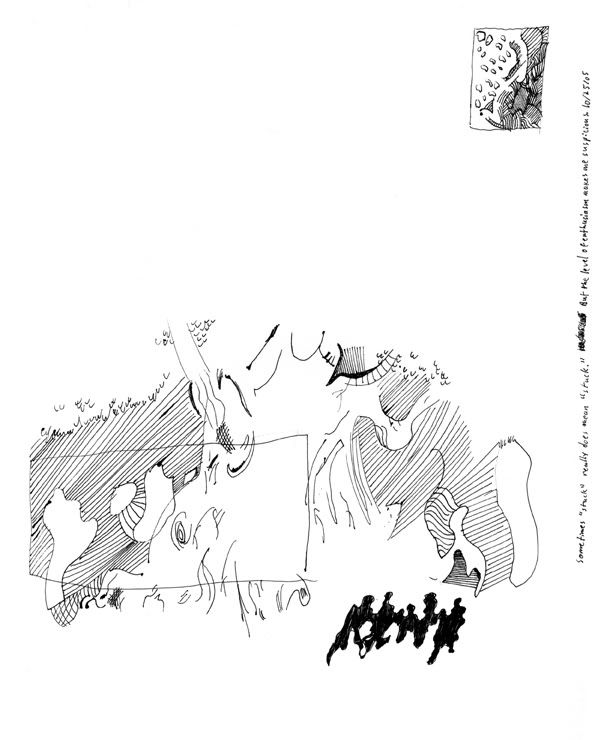
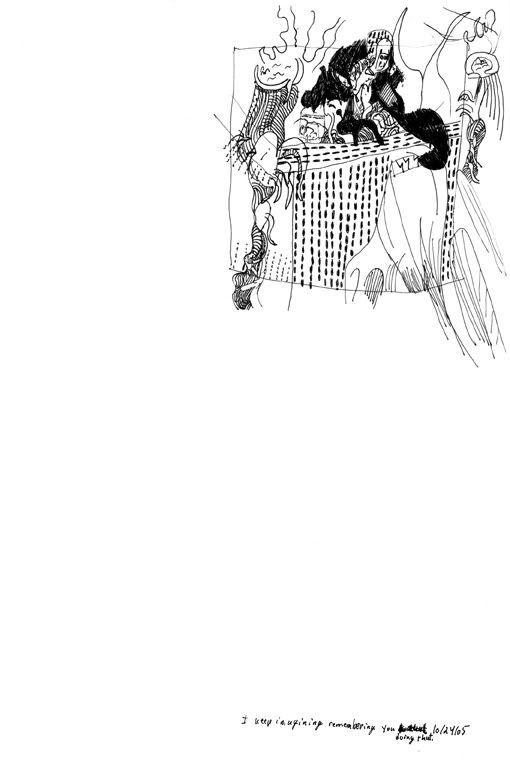
Lolth

Lolth is the god of the dark elves, and the demon queen of spiders. She's also clearly a Sheelob rip off, though it would probably be unwise to tell her so.


Text reads: "I keep imagining remembering you doing that."

Saturday, March 10, 2007

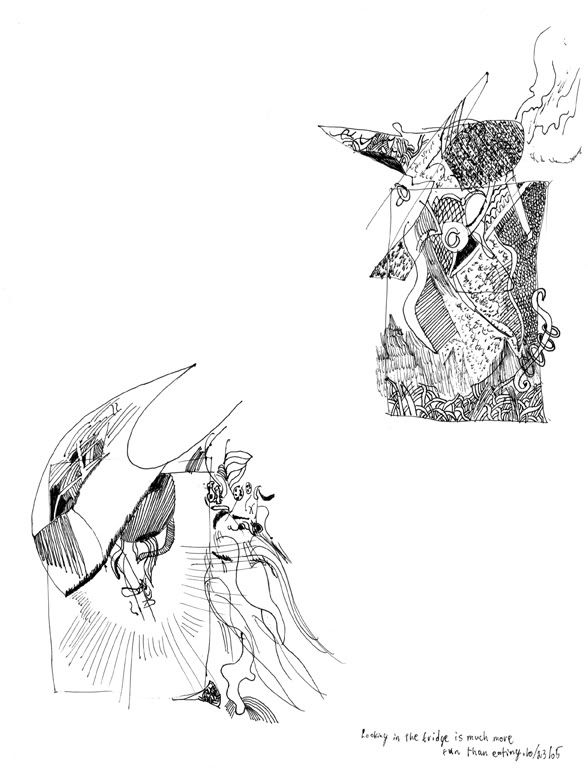
Moradin and Corellon Larethian

Lot of Pseudo-tolkein names here. Moradin is the god of dwarves ("the sould forger"); Corellon Larethian is the god of elves.


Text reads: "Looking in the refrigerator is much more fun than eating."

Friday, March 09, 2007

"Underwater Face Fight"


This is something I have been working on that involves the squeezing of eel faces...


Four color tee design and contest entry.


Pink is the base color of the shirt itself. Not shabby for four colors, I think.

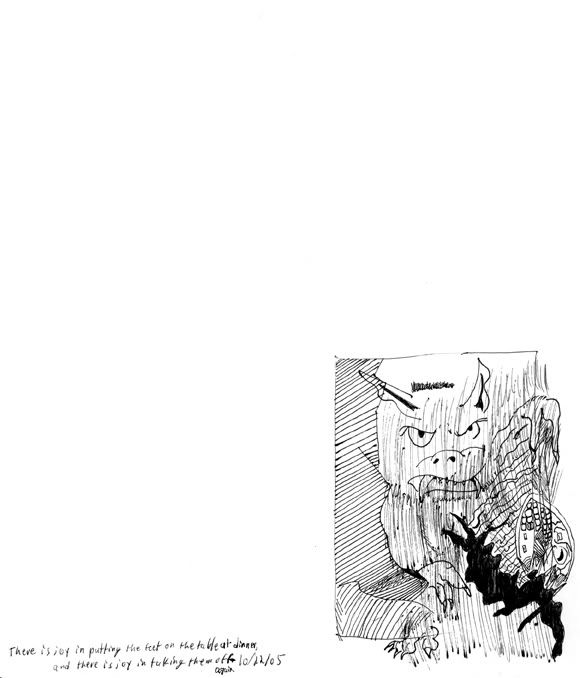
Nonhumans' deities

Back to the god grind. These are gods of various humanoid species, made by D&D nerds for D&D nerds. This is a drawing of the Bugbear god Hruggek.


Text reads: "There is joy in pointing the feet on the table at dinner, and there is joy in taking them off again."

Thursday, March 08, 2007

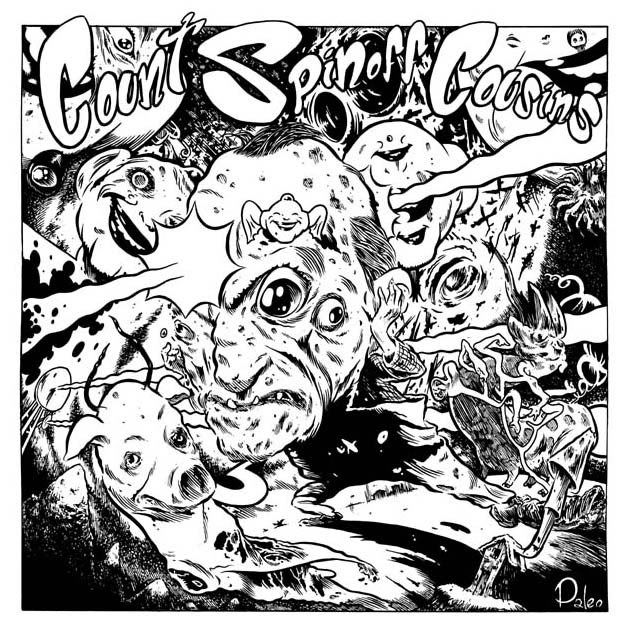
Count Spinoff Cousins


pramlooter

This was drawn for Seantiger's 'world's worst pornstars' zine.

something old, something cthulhu

I thought I'd post something new for once. These are drawings I just finished for that Lovecraft exhibit in Switzerland which Aeron posted about a while ago....


Wednesday, March 07, 2007

Fire Enter


germ ridden wreck


Happiness is an Unhappy Hipster

Luke pointed out this exchange, in which Dave Sim and Jeffrey Brown agree that I am a dick. (Just scroll down a little past the anti-feminist rants.) One of the articles they single out for particular ire is a piece I wrote about Charles Schulz and alternative comics creators for TCJ #265 a couple of years ago. So I thought I'd take the opportunity to reprint it here.

Happiness is an Unhappy Hipster

Charles Schulz was not a fan of underground comics. He thought they were vulgar and boring. “What was strange about them,” he said in an interview with Gary Groth, “was they pretended to be so different and they all turned out to be the same…. What’s so great about that?”

Schulz was referring to an earlier generation of alternative comics, of course. The horny ’60s shock-jocks Schulz despised have long since given way to legions of sensitive new-age artistes selling a very different brand of self-indulgence. And while older underground icons like Harvey Pekar may have sneered at Schulz’s simplicity, the new generation worships him. Chris Ware’s Jimmy Corrigan, for example, is a macrocephalic, self-loathing, perennial loser trapped in a boxy wasteland. Dan Clowes’ mix of suburban surrealism and static non-event would be hard to imagine without Schulz’s example. So would Ivan Brunetti’s long sequences of nearly identical panels filled with neurotic blather. And so it goes. Like one of Al Jafee’s Mad Magazine fold-in covers, the barren landscapes of today’s alternative comics need only to be tweaked or rumpled, and suddenly you’re staring at the same darn enormous head.

Schulz’s influence may be pervasive, but it remains uneasy. Gary Trudeau can gush that Peanuts was the “first Beat strip,” but the fact remains that as a counterculture icon, Charles Schulz lacks something, and I don’t just mean a goatee. Bad enough that his work eschews any reference to sex, politics, or graphic violence — the holy trinity of alternative media. That might be forgivable, or, indeed, inspirational (hey, man, wouldn’t it be great to write a comic like Peanuts, but where all the characters have *sexual*l hang-ups?). But Schulz’s real sin was that everybody liked Peanuts. And when I say everybody, I’m not talking merely about the working-class, or the ethnically diverse, or the other underprivileged groups that we all love to ostentatiously respect. No, I’m talking about the terminally square: the Republicans, the church-goers, the optimists, and the actuaries. I’m talking about Schulz’s longtime friends Cathy Guisewite and Mort Walker, creators of two of the hokiest comic strips ever unleashed on the unwashed herd.

Peanuts’ universal appeal and studied inoffensiveness made it possible for Snoopy to sell lunch boxes, T-shirts, space flight and life-insurance, and for Schulz to create a multi-media marketing empire. But it had its downside as well. In our society, high art is high art because it entertains the elite; low art is low art because it entertains the rabble. The rabble loved Schulz, which left aesthetes with a problem. Peanuts was indisputably great, but could something be great if nobody disputed it? To appreciate Charles Schulz was to make oneself indistinguishable from the football-obsessed, L.L. Bean-attired, homophobic hordes of Middle America. It was, in other words, a hipster’s worst nightmare. Something had to be done.

Luckily, there are tried-and-true strategies for dealing with a crisis of this sort. As Arnold Bennett stated a century ago, “Even when a first-class author has enjoyed immense success during his lifetime, the majority have never appreciated him so sincerely as they have appreciated second-rate men. He has always been reinforced by the ardour of the passionate few.” The masses may like a genius, but they never like him in the right way. That is left to the graduates of small liberal arts colleges, who, with their deeper understanding, love Shakespeare for the profound philosophy, not for the gratuitous gore; Mark Twain for the deep humanity, not for the slapstick.

What, then, do most newspaper readers like about Peanuts? Not too difficult a question: it makes them laugh. Schulz wasn’t embarrassed about this; in fact, he pointed out on numerous occasions that it was the main goal of his work. “Cartooning is, after all, drawing funny pictures,” he wrote in 1975’s Peanuts Jubilee, “something a cartoonist should never forget.” Very well, then; if Joe Average loved Peanuts because of its joy, Joe Above-Average would love it because of its despair. The chosen few understood that Schulz was not a genial neighborhood druggist, but a Jeff Tweedyesque mope rocker; they read the strip not to laugh, but to indulge in an orgy of white, suburban, middle-class self-pity. Or as wunderkind designer Chip Kidd claims, Peanuts was “For all of us who ate our school lunches alone, and didn’t have any hope of sitting anywhere near the little red-haired girl and never got any valentines and struck out every single time we were shoved to the plate for Little League….”

And yet. If Schulz was writing for the alienated and the emotionally deep, why did those tortured souls make such a consistent hash when they tried to pay him tribute? Take Kidd’s The Art of Charles M. Schulz, for example. Along with sketches and strips reproduced at every conceivable size, Kidd also included pictures of tschotskes —dolls, magazine covers, promotional materials, and so forth, all bunged together through the miracle of the latest in page-layout software. As Kidd points out, Schulz’s aesthetic was one of minimalism. Why, then, is this celebration of him so cluttered?

If Kidd’s take on Peanuts is mystifyingly wrong-headed, Jeff Brown’s is infuriating. Chris Ware actually compared Jeff Brown to Schulz in a recent issue of Comic Art; both, he argued, were artists who eschewed realism in order to create a world that was “more heartfelt and real.” I don’t doubt that Brown’s description of his own deep sincerity is “real,” at least to him; unfortunately, that does not make it more endearing. In a piece from Kramer’s Ergot Four called “Don’t Look Them In the Eye,” for example, Brown draws himself at work in a Peanuts-like moment, jumping every time the phone rings because he thinks it might be his girlfriend. But, of course, it never is. Also, she won’t have enough sex with him. How poignant.

Brown’s work, in fact, is a perfect example of how alternative comics types have take from Schulz one or two stylistic tics while systematically abandoning everything that made Peanuts worth reading. Even a cursory comparison of Jeff Brown’s artwork and Schulz’s demonstrates the enormous gulf between the two. Schulz’s drawings are deliberately simplified; especially in his classic 50s and 60s work, he chooses one or two details carefully to set a scene. What he does choose to draw is rendered idiosyncratically but distinctively — Schroeder’s piano, for instance. And despite the simplicity of the drawing, some of his effects can take your breath away. In the strip I’m looking at right now, Linus and Charlie Brown dissolve into a driving rainstorm, the perspective slowly pulling away from them, until each stands alone, almost completely obscured by the thicket of varied pen strokes. Schulz was charmingly pleased with his ability to create such effects; as he wrote in 1999s Peanuts: A Golden Celebration, “Rain is fun to draw. I pride myself on being able to make nice strokes with the point of a pen….”

Needless to say, this sort of grace is way beyond Jeff Brown. In one scene, Brown is lying in bed with his girlfriend. Crosshatch lines are everywhere; on the walls, on their bodies, on the bed, all running in different directions. We shift from close-up to mid-distance shot to close-up and back to mid-distance, all for no apparent reason. There’s no progression or unity, and the sloppiness is not so much engaging as it is profoundly half-assed. Brown has taken Schulz’s iconic, non-representational style, but left out the reserve and discretion which makes it work. This is brought home most clearly in the middle of “Don’t Look Them In the Eye,” when Brown, more or less at random, includes a blob-like drawing of Snoopy’s friend Woodstock. The best that can be said of this attempt is that Brown’s version, like Schulz’s, looks nothing like a bird.

After the dismal art, the most noticeable thing about Jeff Brown’ work is that every panel features — Jeff Brown. No surprise there; if the super-hero is the fetish of the mainstream, the self is the fetish of the art comic. Perhaps the autobiographical vogue is some sort of overreaction to the shared worlds, house styles, and character ownership of DC and Marvel. Or perhaps it’s simply a solipsistic failure of imagination. In any case, there is little doubt that many in the alternative comics field have difficulty distinguishing between the phrases “personal vision” and “narcissism.”

Unfortunately, as it happens, many of the deities worshipped by the alternative comics crowd — Jack Cole, Winsor McCay, George Herriman, etc., etc. — simply didn’t write confessional narratives (it’s been argued that some of Jack Cole’s work was semi-autobiographical. This is simply too silly to argue about.) Charles Schulz, though, was a different matter. Charlie Brown had, after all, the same first name as his creator; his father, like Schulz’s, was a barber. Schulz even admitted that Charlie Brown’s unrequited affection for the little red-haired girl had its basis in Schulz’s own romantic rejection at the hands of a red-headed woman named Donna Mae Johnson.

Commentators eager to establish Schulz’s high-art credentials have been quick to pick up on these hints. In his Afterword to the first volume of the Complete Peanuts, for example, David Michaelis compares Schulz to Charles Dickens, Mark Twain, and — oddly enough — Henry James. The heart of the essay, though, is the insistence that Peanuts was based on Schulz’s own “lifelong sense of alienation, insecurity, and inferiority.” In a recent Chicago Reader article, Ben Schwartz makes pretty much the same point. Both Schwartz and Michaelis dwell lovingly on the most painful aspects of Schulz’s biography — his troubles in school, his mother’s early death, his wartime service. Schulz is great, in other words, because he has suffered: because of who he is as much as because of what he did.

Schulz is credited, then, with using the comic strip to reveal his own tortured soul. In the fifties, when Peanuts started, the triumphant flourishing of psychic wounds was as common as Bildungsromans in literary fiction. On the funnies page, though, it was a novelty. No more; if it’s whining, insular self-reference you want, art comics are now the go-to genre. Cartoonists today routinely write entire strips devoted to the great suffering one experiences as a cartoonist. When Dan Clowes did a cover for the Comics Journal a while back, he filled it with ruminations on how hard it was to create a cover for the Comics Journal. In Maus, Art Spiegelman wrote about how hard it was to write Maus. Ivan Brunetti and Chris Ware have both written comics about the terrible, existential pain of writing comics. And both Brunetti and Ware have justified them with the same quote from none other than Charles Schulz: “Cartooning will destroy you. It will break your heart.”

As those words indicate, Schulz did have something of a chip on his shoulder about the low status of comics writers. He also felt that writing the strip year after year, and coming up with ideas day after day, made cartooning “very demanding.” For the most part, though, he kept his problems in perspective. “Every profession and every type of work has its difficulties,” he noted, and added, “I don’t want anyone to think that what I do is that much work..” Whatever his frustrations, therefore, the strip never descended to bathetic self-dramatization. Charlie Brown whined about sports, or camp, or his dog, or the little red-haired girl. But he never whined about the spiritual trauma of being a rich and famous cartoonist.

And why should he? Charlie Brown was never a stand-in for Charles Schulz. Indeed, in A Golden Celebration, Schulz argues that Charlie Brown is the *least* realistic of the Peanuts cast. “He’s certainly the only character who’s all one thing,” Schulz points out. “He’s a caricature.” Obviously, Charlie Brown’s hyperbolic suffering is an aspect of Schulz’s psyche. But so are Schroeder’s virtuosity, and Sally’s indignation, and Linus’ spirituality, and Snoopy’s preposterously fertile imagination. So is Lucy, who comes, Schulz says, “from that part of me that’s capable of saying mean and sarcastic things….” Sure, Schulz is the kid who always misses the football. But he’s also the kid who always pulls it away.

So, yes, Charlie Brown was important to Peanuts. But he didn’t define the strip and he didn’t define Schulz. This can be a painful realization for those who value earnestness in their art. Critic Christopher Caldwell, for example, wrote an essay for the New York Press in which he took a bold stand against Snoopy’s happy dance and complained that in its later years Peanuts had moved from “heartbreaking” to “sentimentalism.” It’s an interesting thesis, but one that ignores an important point: Schulz always mixed a fair bit of sweet with his bitter. One Sunday strip in the 60s, for example, showed us a crabby Lucy wandering around the house and bitching. “Count your blessings,” Linus advises, which only prompts another tirade. “What do I have to be thankful for?” she demands. “Well for one thing,” Linus replies, “You have a little brother who loves you….” Lucy pauses for a panel…and then clutches Linus and breaks into tears. “Every now and then I say the right thing,” Linus muses as he hugs her back.

I doubt Caldwell or his ilk would like that strip very much I doubt they’d like the series in the 90s where Charlie Brown gets a girlfriend either. Or the utterly bizarre Sunday comic where the punchline is Snoopy looking at a golf ball in a water trap and thinking, “That doesn’t look like Moses.” Or the one which consists entirely of Sally discussing how her eye patch will cure her amblyopia (there is no discernable punchline.). Or the one where Charlie Brown explains to a deeply grateful Linus that the cure for disillusionment is a chocolate cream and a friendly pat on the back. These strips aren’t grim; they aren’t existential. Presumably, they aren’t true to Peanuts tragic essence. But the essence of the strip was never Schulz’s sadness. It was his professionalism, his inventiveness, and, above all, his sense of humor. After all, any idiot can tell you that life sucks. When they do, though, I wish they wouldn’t pretend they got the insight from poor ol’ Charlie Brown.

Tuesday, March 06, 2007

Ride On A Troll


Recent drarering, it's not entirely evident in this one but I'm pushing for a drawing style that will be difficult to tell if it was made recently or 500 years ago.

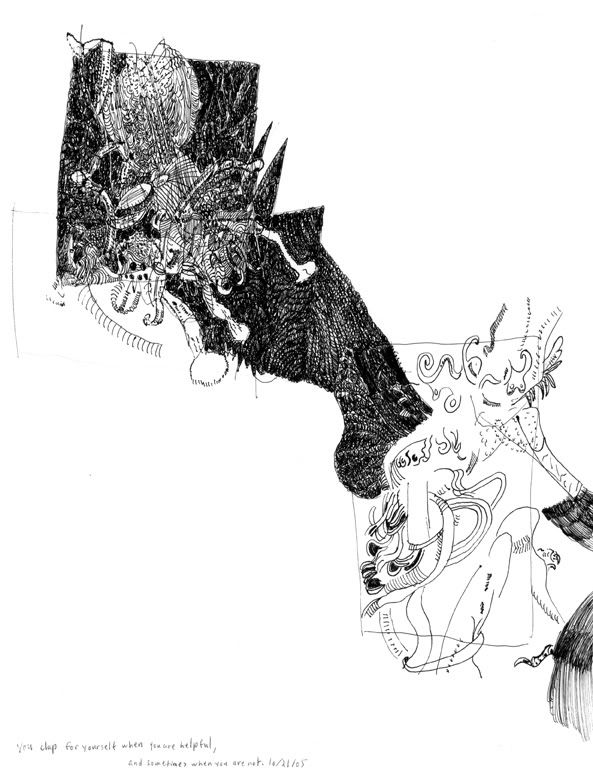
Spider God, Salt Spider, Tyaa

The Spider God is what it sounds like; the salt spider is a spider the size of a pig; Tyaa is the winged goddess of evil birds.


Text reads: "You clap for yourself when you are helpful, and sometimes when you are not."

Monday, March 05, 2007

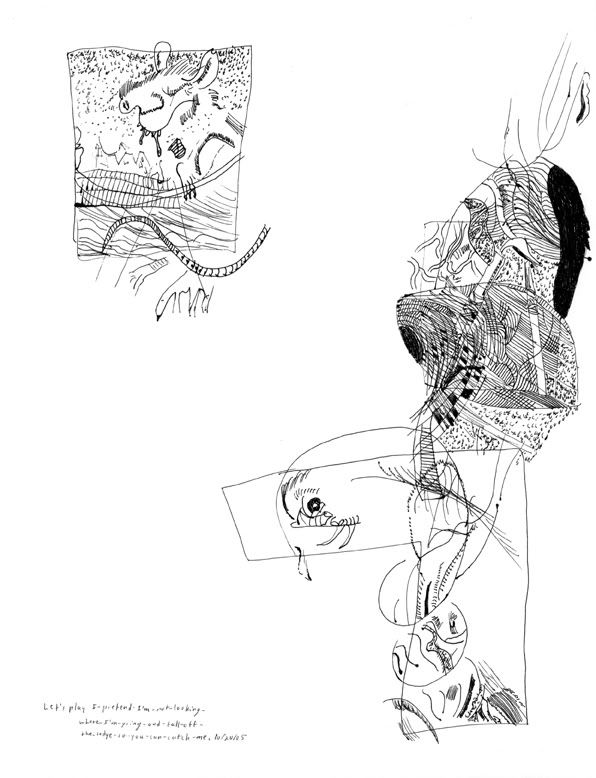
Rat God, Sheelba of the Eyeless Face, Snow Serpent

Rat God is pretty much what it sounds like; Sheelba is a wizard/demon creature who wears a cloak and no face; a Snow serpent is also pretty much what it sounds like.

This drawing resoundingly failed to impress Jesse Hamm.


Text reads: "Let's play I-pretend-not-to-look-where-I'm-gong-and-fall-off-the-edge-so-you-can-catch-me."

Band Illustration


This is a little illustration done for a friend's band. They asked for it a week ago and, by the time I finished it, they had already broken up. Ahh, such is the way with music, I guess.
Yesterday's adventure through the Picc-a-Dilly Flea Market proved excellent. My number one acquiration was four unopened packs of Topps Pee Wee's Playhouse Fun-Pak cards. This was maybe too exciting for me to deal with. Each Fun-Pak comes with 1 sheet of tattoos, 3 trading cards, 1 sticker, 1 wiggle toy (one of those deals where you turn it one direction & see an image & turn it another direction & you see another image) & 1 activity card. All designed or at least art-directed by Gary Panter. I'm dying! I also got about a hundred Wacky Packages cards for $2 (deal on the meal!), a pack of Desert Storm cards (mostly for the intact wax pack so that i can copy the exact measurements & create my own.), this Blackstar Alien Demon toy that i was totally obsessed with as a kid & bunch of other cool junk.


Also included in today's feature is major kudos for this spot right near our house here in Eugene. Papa's Soul Food Kitchen & Blues Joint is always packed & the food is GODDAMNED GOOD & the right price. You can get giant mason jars of kool-aid as well, which is pretty funky if you ask me. It's just about perfect excepting that i'm not so excited by the blues & the clientele isn't so soulful either, a bunch of tighty whities actually, this being Oregon & all. But i was there, so it works out. Also in the world of Funkanopolis, you should check out this show "THE HISTORY OF FUNK" hosted by the Rickey Vincent Uhuru Maggot. http://www.kpfa.org/1pro_bio/1b_histo.htm It's just about the best show on KPFA, especially because it isn't a bunch of whining about desert nations & their oily, explosive troubles. But speaking of politics, i also recommend KPFA's GUNS & BUTTER http://www.kpfa.org/archives/index.php?show=13 & AGAINST THE GRAIN http://www.kpfa.org/archives/index.php?show=47 . I counter their socialist propagandizing with the also totally awesome Alex Jones show. http://www.infowars.com/ He's out there smashing the New World Order, which sounds good to me. I figure if i listen to a wide mix of news & opinions I can at least figure out what agendas are being perpetuated. Politics are quite difficult for me to make my mind up about these days. My back-up argument is "F*CK THEM ALL". In a way, it's quite relieving.

Sunday, March 04, 2007

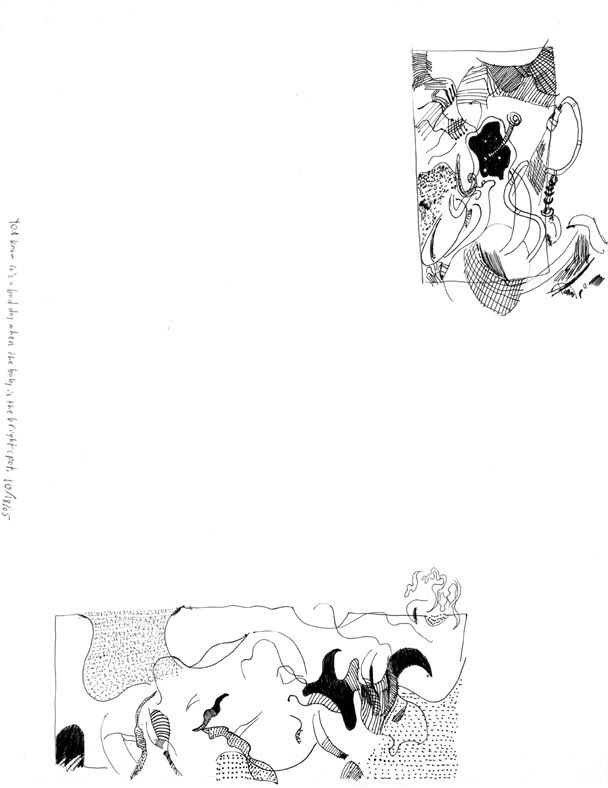
Nehwon Earth God; Ningauble of the seven eyes

The earth god is a piece of earth; Ningauble is a kind of wizard demon thing; it's got a hooded cloak with seven eyes floating around in it.


Text reads: "You know it's a bad day when the baby is the bright spot."