

Showing posts with label Nuvish. Show all posts
Showing posts with label Nuvish. Show all posts
Sunday, August 30, 2015

Sunday, September 07, 2014
Sous vide #1

Cover : Nuvish
Drawings : Gaspard Pitiot, Eric Demelis, Mattt Konture, Nuvish,
Caroline Dahyot, Shaltmira, Hui Zheng, Jo 99, Dominique Lucci, Delphine Cadoré,
Hanna Chroboczek, Adrien Fregosi, Alkbazz, Zeke Clough
Texts (in french) : Danielle Tolédano, Gaspard Pitiot, Alain Bouillet, Hui Zheng, Louis Doucet,
Eric Ferber, Laurent Briet, Armand Dupuy, Cédric Demangeot, Jean-François
Massol
Tuesday, March 09, 2010
Interview with Ludovic Levasseur
G: Would maggots in the nose be an acceptable mean to heal the brain?
L: Like Père Ubu I would say the brain, in decomposition and being nibbled on by maggots, functions beyond death, and it is its dreams which are heaven…

http://www.flickr.com/photos/ah-pook/

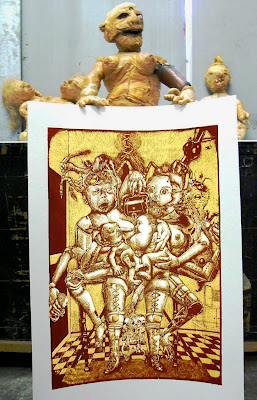


L: Like Père Ubu I would say the brain, in decomposition and being nibbled on by maggots, functions beyond death, and it is its dreams which are heaven…

http://www.flickr.com/photos/ludovic-levasseur/
G: I distinguish different moments in violence: its premonition, its execution and its result… I noticed that in your drawings those three moments seem to coincide… Are you not fascinated by some kind of damnation, post mortem suffering and a sin which never ceases to be accomplished?
L: Certainly not, the only thing there is after death, if we aren’t mummified, is the decomposition of our body’s tissues. I am totally free of any religious preoccupation and in general so are my images, neither while I draw them nor afterwards.
I try to fill the surface with a maximum of intensity, in each case with the elements which I find graphically - and therefore intimately - satisfying: it is perhaps here where the vice lies. You never knows why this or that form satisfies or displeases you. It is without a doubt a kind of abundance whithin the image which gives you the impression of simultaneous moments, an atmosphere of generalised violence, which is, from my point of view, difficult to dissect into a sequence. Anyhow, I’m generally not in favor of psychological interpretations of works of art, and I’m not talking only about my own images. I certainly would have difficulties drawing a flowerpot; and I also viscerally reject the sketchiness of a certain kind of pseudo-contemporary drawing.
G: It seems like the things you reject, find disgusting or hate are the same as mine… disdain and lucidity simply are delicious means to enter into a highly subjective view: I was very touched by your affirmation of intimacy. Am I wrong or does it seem like your drawings are evolving towards a certain “harmony” or at least more of an equilibrium in the characters’ relations, more ambivalence? There seems to be a growing restraint in them…
L: I have the impression that as time passes we find sneakier ways to say things which we used to assert in a more straight forward manner before, in art or any other practice. Language is becoming more complex because our vocabulary is growing, at least it ideally should be like that. One should try to become more and more radical but in a more and more subtle way, in a double self-contradictory move: these are great principles though, easier to proclaim than to follow.

http://www.flickr.com/photos/ah-pook/
G: Your drawings of carnage (which have a baroque aftertaste) suggest some effort of staging or composition; how much of it is improvisation?
L: By the same logic of there not being any preconceived idea or imposed significance, I don’t anticipate any composition a priori, the whole arranges itself –or doesn’t - in the course of something like an improvisation. All my difficulties come from that. In fact, I spend my time pruning, trying to harmonise something which is often wobbly. Well, it doesn’t seem to me that I make so many carnages… The baroque aspect - as you call it - of my backgrounds probably stems from a slightly decorative anxiety, a will not to end up in the total violence that the elements of the foreground would often suggest.
G: Yes, I used the word “baroque” more or less like that: cluttered, but also in terms of the line, which is not “ideal” but mostly vivacious, stark and with various ruptures. I wonder about how you draw… Do you think you’re rather nervous, dreamy, precise, slow, or fast in your gesture?
L: If the line isn’t ideal, it is actually in spite of myself ! I can’t do better. I am slow and precise, and very compelled by engraving. Always weighing the pros and cons, trying to harmonise as one goes along. It is quite laborious with rather long periods of discontinuation. Maybe the ruptures result from this. I must be lazy, incapable of working tightly all the time. Well, the best things generally come quickly, that is quite evident. However, there is no absolute rule: sometimes it is torture to achieve a satisfying result.
G: Yes, I used the word “baroque” more or less like that: cluttered, but also in terms of the line, which is not “ideal” but mostly vivacious, stark and with various ruptures. I wonder about how you draw… Do you think you’re rather nervous, dreamy, precise, slow, or fast in your gesture?
L: If the line isn’t ideal, it is actually in spite of myself ! I can’t do better. I am slow and precise, and very compelled by engraving. Always weighing the pros and cons, trying to harmonise as one goes along. It is quite laborious with rather long periods of discontinuation. Maybe the ruptures result from this. I must be lazy, incapable of working tightly all the time. Well, the best things generally come quickly, that is quite evident. However, there is no absolute rule: sometimes it is torture to achieve a satisfying result.

G: The dolls, being material entities detached from context, agonise or exult in there innermost being. I’m curious; could you to tell us more about them, their fabrication, their sizes and maybe the little more sentimental things which are related to them…
L: On the contrary, to me they are dead objects, rather mummified, fossilised… Products of taxidermy. In my mind, they have to be ancient things, or impossible to date. Also, I need to be scared when making them, and as a result they cause some kind of deadly fear in the viewer. Here, causing reactions is easier than with two-dimensional images; but again I try not to get as dark and disturbing as the “Grand guignol” (puppet show). Im not sure if I mange to…
L: On the contrary, to me they are dead objects, rather mummified, fossilised… Products of taxidermy. In my mind, they have to be ancient things, or impossible to date. Also, I need to be scared when making them, and as a result they cause some kind of deadly fear in the viewer. Here, causing reactions is easier than with two-dimensional images; but again I try not to get as dark and disturbing as the “Grand guignol” (puppet show). Im not sure if I mange to…
I started with little runts of 15 cm and ended up with adult size mannequins, with some baby sized and one or two adolescent sized monsters along the way. I’m more attached to some of them, not for sentimental reasons but quite simply because I feel like they’re greater thechnical achievements. It’s a practice to which I’ve devoted myself for only a few years now , and it used to function as a sort of recreation in relation to engraving. I more or less invented my mixtures myself and, if it can be said, I “progressed” rather quickly in this bizarre technique. In general I oscillate between the two practices. At the moment, I’ve stopped with the dolls. Anyhow, there isn’t necessarily a link between the two activities, in some ways, they’re each other’s polar opposites.


G: You pursue quite a wide range of activities; in addition to drawing and the dolls you also produce etchings. Anne Van der Linden, Nuvish, Remi, Caroline Sury have a collection of images which you printed for them…
L: I don’t do drawings, except for some sketches here or there, I exclusively do engravings - for its rigid rules, not because of a taste for constraints, but enables me to canalise the mess a bit. There is the resistance of the technique.
You’re right to speak of a “collection”. It is when seeing how we worked at Le Dernier Cri, with Pakito Bolino and Caroline Sury, that got the taste for the adventure of working in a collective and I felt like “publishing” those friends, whose graphic oeuvre I admired and, when done as engravings, I thought would produce great results, and it wasn’t a failure.
They conceived the drawings, then etched them on plates that I had given them. At this point I have printed about twenty etchings: four portfolios by Remy, Caroline Surry, Nuvish and Anne Van der Linden who, by the way, goes on doing engravings at my home and with whom I’m doing an exhibition soon*.
L: I don’t do drawings, except for some sketches here or there, I exclusively do engravings - for its rigid rules, not because of a taste for constraints, but enables me to canalise the mess a bit. There is the resistance of the technique.
You’re right to speak of a “collection”. It is when seeing how we worked at Le Dernier Cri, with Pakito Bolino and Caroline Sury, that got the taste for the adventure of working in a collective and I felt like “publishing” those friends, whose graphic oeuvre I admired and, when done as engravings, I thought would produce great results, and it wasn’t a failure.
They conceived the drawings, then etched them on plates that I had given them. At this point I have printed about twenty etchings: four portfolios by Remy, Caroline Surry, Nuvish and Anne Van der Linden who, by the way, goes on doing engravings at my home and with whom I’m doing an exhibition soon*.
In my mind, by conceiving those engravings the four of them have delivered the most intimite part of the oeuvre, the one which touches me in their respective art. The emulation is mutual, it in turn motivates me to try to do things a bit better than usual. It is an adventure which permits you to move away from your own little artistic narcissistic belly button. There are few things more interesting to do with people than working with them.

http://www.flickr.com/photos/ah-pook/
G: What does your workshop looks like?
L: It is my home, I live in it: my engraving workshop is in the lounge, the acid trays are in the garage or in the bathroom during winter. I tinker about a little bit in every room. I varnish my copper plates in the kitchen, the dolls are in the cubby-hole and on the walls, and I fabricate them in the garden when it’s sunny outside.
G: How much do your working materials cost?
L: It is my home, I live in it: my engraving workshop is in the lounge, the acid trays are in the garage or in the bathroom during winter. I tinker about a little bit in every room. I varnish my copper plates in the kitchen, the dolls are in the cubby-hole and on the walls, and I fabricate them in the garden when it’s sunny outside.
G: How much do your working materials cost?
L: After having frequented a workshop for a long time where all materials were there, but where I couldn’t work at my leisure, I bought a second hand press a few years ago. The principal expenses concern the paper and especially the copper the market price of which hasn’t risen for few years but underwent a surge some time ago. I always keep an eye on metal prices, I’d really like to print on silver and gold, but it is too expensive. The dolls are predominantly made up out of found ingredients, culled at the beach and pulled out of the dentists’ and fishmongers’ garbage cans.
Anyway, as a general rule, in addition to the material cost the artistic practice -like culture itself - isn’t a very democratic thing. If only for the time which it takes, it is relatively incompatible with salaried employment.
G: How long does it take to make an etching ?
L: That’s a question which often turns up. It’s difficult to quantify. It depends on the way each one works, Remi for example can work quick and effectively, while Nuvish will obsessively perfect his lines. I for my part am rather slow, it can take three or four weeks to make the drawing if I work on it a bit every day, which is scarcely the case. Sometimes I put the plate aside for six months if I don’t get the results I wanted, and then I take it up once more. One cannot expect to produce more than fifteen good engravings in one year. And I don’t even think I’ve ever managed as much as that.
G: How many printings are possible?
L: At the moment I’m doing drypoint engravings on zinc; there I will get less than twenty good prints and not even ten definitive achievements. It’s possible to do fifty prints from an etching on copper, but I never did as many from an engraving, I favour small editions. The biggest print runs were the ones for the portfolios I edited, between 20 and 30 prints.
G: Have you ever tried the mezzotint?
L: I think that the drypoints that I do at the moment look like mezzotint, setting aside the laxness. I won’t engage in this technique which is, after all, quite boring. It would require employing a rocker for days to roughen the plate, or buy plates already prepared, but those are very expensive. But I generally find that this technique produces somewhat weak images.
Anyway, as a general rule, in addition to the material cost the artistic practice -like culture itself - isn’t a very democratic thing. If only for the time which it takes, it is relatively incompatible with salaried employment.
G: How long does it take to make an etching ?
L: That’s a question which often turns up. It’s difficult to quantify. It depends on the way each one works, Remi for example can work quick and effectively, while Nuvish will obsessively perfect his lines. I for my part am rather slow, it can take three or four weeks to make the drawing if I work on it a bit every day, which is scarcely the case. Sometimes I put the plate aside for six months if I don’t get the results I wanted, and then I take it up once more. One cannot expect to produce more than fifteen good engravings in one year. And I don’t even think I’ve ever managed as much as that.
G: How many printings are possible?
L: At the moment I’m doing drypoint engravings on zinc; there I will get less than twenty good prints and not even ten definitive achievements. It’s possible to do fifty prints from an etching on copper, but I never did as many from an engraving, I favour small editions. The biggest print runs were the ones for the portfolios I edited, between 20 and 30 prints.
G: Have you ever tried the mezzotint?
L: I think that the drypoints that I do at the moment look like mezzotint, setting aside the laxness. I won’t engage in this technique which is, after all, quite boring. It would require employing a rocker for days to roughen the plate, or buy plates already prepared, but those are very expensive. But I generally find that this technique produces somewhat weak images.

G: How do you evolve in your artistic environment?
L: I’ve made very few efforts to artistically socialise, very few efforts in general, except the ones which seemed worth it; this could appear flimsy, but I’m satisfied with it: I exhibited in the world‘s best library, Un Regard Moderne in Paris, I publish and exhibit with the best editor of the world, Le Dernier Cri à Marseille, and I worked with artists who are among the closest to me, the ones I mentioned, as well as Marie Noël Döby, whom I made hybrid dolls with, or Le Tampographe Sardon who edited “Poupée Viande”, a box of rubber stamps.
Right now I’m hesitating between two contradictory plans: either going deeper into what I’ve already been doing with the same people, and try to do it a little better still - or quitting this deplorable artistic activity to exclusively devote myself to the practice of curling, trying to be good enough to be selected for the next world championship… which, considering the small number of practitioners of this sport in France, shouldn’t be too difficult.
* Anne Van der Linden et Ludovic Levasseur : Gravures et dessins, du 27 février au 27 mars 2010. Galerie Une poussière dans l’œil, 17 bis, chemin des Vieux arbres, 59650 Villeneuve d’Ascq.
Right now I’m hesitating between two contradictory plans: either going deeper into what I’ve already been doing with the same people, and try to do it a little better still - or quitting this deplorable artistic activity to exclusively devote myself to the practice of curling, trying to be good enough to be selected for the next world championship… which, considering the small number of practitioners of this sport in France, shouldn’t be too difficult.
* Anne Van der Linden et Ludovic Levasseur : Gravures et dessins, du 27 février au 27 mars 2010. Galerie Une poussière dans l’œil, 17 bis, chemin des Vieux arbres, 59650 Villeneuve d’Ascq.

http://www.flickr.com/photos/ludovic-levasseur/
Liens :
Gravures (et portfolios) : http://www.flickr.com/photos/ah-pook/
Le dernier cri : http://www.lederniercri.org/
Anne Van der Linden : http://heavyshop.free.fr/
Rémi : http://remi.over-blog.fr/
Sardon (coffret « Poupée Viande ») : http://le-tampographe-sardon.blogspot.com/2009/09/poupee-viande.html
Marie Noël Döby : http://lesdobys.free.fr/index2.html
Sunday, April 05, 2009
The Drawings of Nuvish
Last year I went to two exhibitions of Nuvish in Grenoble. Straight away I remembered some drawings which I had seen in Hopital Brut (published by Le Dernier Cri). It was incredible to actually realise that the originals were miniatures. Some of them are displayed on his blog here.
His flat is situated in a quaint lane. We started talking about a nearby squat which now has been destroyed because I remembered I played some music with No Mad six years ago there. He introduced me to his family and we went upstairs to have a look at his work. He showed me first a very dark etching.
.

Nuvish: I spend one month full time to draw each picture.
We were sitting on the floor of a square room under the roof. Most of his drawings were framed for his next exhibition which will takes place at Entr’arts 4 rue Marx Dormoy in Grenoble from the 29th of April to the 6th of June. The etchings and the screen prints were on the floor carefully wrapped.
Nuvish: I spent three years with Le Dernier Cri in Marseille. We worked eight hours a day. When I came home I spent my evenings drawing.
Sggum: Did they pay you?
Nuvish: Yea, it was a “Emploi Jeune”.
Sggum: How long have they been in Marseille for?
Nuvish: Wait a sec… Since 1997 I think.
Sggum: Did you meet them in Marseille?
Nuvish: No, It was in Paris. They had their workshop in the squat of Ris-Orangis in the suburbs. .
.

.
We looked at some scale model which he made for the animated film Les Religions Sauvages produced by LDC. They portray bleak free parties. He showed me the different materials he used to allow the spots behind to create visual effects. We spoke about Léo and he said to me that he was a good friend of him. I started to look once more at a A1 screen print which is a view of Grenoble. In the background stands La Bastille (a fort which was designed by Vauban in the Renaissance). I was amazed that actually the screen print is maybe height time bigger than the original drawing (he sold it some times ago) and it still contains so many little details.
Sggum: Where exactly did you draw it?
Nuvish: There was an undeveloped land in Rue du Vercors.
Sggum: Hey! That’s where I live!
Nuvish: It doesn’t exist anymore there is a parking instead. There used to be bushes and trees in it.
Sggum: Did you draw it there?
Nuvish: No I did it from memory at home. I went there quite often because I am very much interested in plants. I sketched some of them.
I immediately remembered that two weeks ago he had said to me on the phone that loads of his work focused on the border between city and nature. I situated once more the bird and the cat hidden in the picture.
Nuvish : One afternoon a cat was tracking a bird.

Nuvish: It’s a shame I don’t have any copy of my first comics here. I self-published it when I was fifteen years old. That’s when I decided to draw a lot: I though nothing else did matter.”
We went downstairs to have a look at his books. He showed me the plate he is carving to produce etchings with Ludovic Levasseur. One of them symbolises nuclear waists.
Nuvish: For the etching which I showed you when we were upstairs I drew beneath the bridge over Le Drac so I could get the perspective right.
We had a look at his books and actually it was a bit frustrating because I knew that they were all sold out.
Sggum: This style looks like the drawing you made for La Monstrueuse! (Edited by Chacal Puant, Blanquet).
Nuvish: It is the same period.

.
He evoked once more Le Dernier Cri and Paquito Bolino’s temperament: very active and directive.
Nuvish: LDC tried many different strategies to promote their work. Pakito is “branché” (chuckles). He is very aware of many graphic techniques. Have a look at this book, Pakito coloured it some times ago.
We started to speak about the texts which were present in the books produced by LDC and he said to me that Leatitia and Fredox did travel a lot. He showed me a book with a cover by Fredox and I couldn’t recognize his style.
Nuvish: Fredox has many different abilities. He has worked for Jean Paul Gauthier for ten years. He makes visuals.
When we spoke about mental institution he said to me that we were fragile little things.

Sggum: Hey! The title of this painting is "Kundalini"! The serpent of fire!
Nuvish: Some mysticisms look at the pelvis as being the skull of a saurian.
I remembered that two weeks ago after I’d said to him on the phone that I had the impression that some of his work was about transfiguration and transformation, strangely he stayed silent.
.

.
It was time for the kids to go to bed so I left. I realised on the way to my flat that I had lost my keys. So I came back to his place. I knocked very quietly in order not to wake his children up. My keys had fallen from my pocket when we sat on the floor to look at his drawings.
.


http://nuvish.wordpress.com/
His flat is situated in a quaint lane. We started talking about a nearby squat which now has been destroyed because I remembered I played some music with No Mad six years ago there. He introduced me to his family and we went upstairs to have a look at his work. He showed me first a very dark etching.
.

Nuvish: I spend one month full time to draw each picture.
We were sitting on the floor of a square room under the roof. Most of his drawings were framed for his next exhibition which will takes place at Entr’arts 4 rue Marx Dormoy in Grenoble from the 29th of April to the 6th of June. The etchings and the screen prints were on the floor carefully wrapped.
Nuvish: I spent three years with Le Dernier Cri in Marseille. We worked eight hours a day. When I came home I spent my evenings drawing.
Sggum: Did they pay you?
Nuvish: Yea, it was a “Emploi Jeune”.
Sggum: How long have they been in Marseille for?
Nuvish: Wait a sec… Since 1997 I think.
Sggum: Did you meet them in Marseille?
Nuvish: No, It was in Paris. They had their workshop in the squat of Ris-Orangis in the suburbs. .
.

.
We looked at some scale model which he made for the animated film Les Religions Sauvages produced by LDC. They portray bleak free parties. He showed me the different materials he used to allow the spots behind to create visual effects. We spoke about Léo and he said to me that he was a good friend of him. I started to look once more at a A1 screen print which is a view of Grenoble. In the background stands La Bastille (a fort which was designed by Vauban in the Renaissance). I was amazed that actually the screen print is maybe height time bigger than the original drawing (he sold it some times ago) and it still contains so many little details.
Sggum: Where exactly did you draw it?
Nuvish: There was an undeveloped land in Rue du Vercors.
Sggum: Hey! That’s where I live!
Nuvish: It doesn’t exist anymore there is a parking instead. There used to be bushes and trees in it.
Sggum: Did you draw it there?
Nuvish: No I did it from memory at home. I went there quite often because I am very much interested in plants. I sketched some of them.
I immediately remembered that two weeks ago he had said to me on the phone that loads of his work focused on the border between city and nature. I situated once more the bird and the cat hidden in the picture.
Nuvish : One afternoon a cat was tracking a bird.

Nuvish: It’s a shame I don’t have any copy of my first comics here. I self-published it when I was fifteen years old. That’s when I decided to draw a lot: I though nothing else did matter.”
We went downstairs to have a look at his books. He showed me the plate he is carving to produce etchings with Ludovic Levasseur. One of them symbolises nuclear waists.
Nuvish: For the etching which I showed you when we were upstairs I drew beneath the bridge over Le Drac so I could get the perspective right.
We had a look at his books and actually it was a bit frustrating because I knew that they were all sold out.
Sggum: This style looks like the drawing you made for La Monstrueuse! (Edited by Chacal Puant, Blanquet).
Nuvish: It is the same period.

.
He evoked once more Le Dernier Cri and Paquito Bolino’s temperament: very active and directive.
Nuvish: LDC tried many different strategies to promote their work. Pakito is “branché” (chuckles). He is very aware of many graphic techniques. Have a look at this book, Pakito coloured it some times ago.
We started to speak about the texts which were present in the books produced by LDC and he said to me that Leatitia and Fredox did travel a lot. He showed me a book with a cover by Fredox and I couldn’t recognize his style.
Nuvish: Fredox has many different abilities. He has worked for Jean Paul Gauthier for ten years. He makes visuals.
When we spoke about mental institution he said to me that we were fragile little things.

Sggum: Hey! The title of this painting is "Kundalini"! The serpent of fire!
Nuvish: Some mysticisms look at the pelvis as being the skull of a saurian.
I remembered that two weeks ago after I’d said to him on the phone that I had the impression that some of his work was about transfiguration and transformation, strangely he stayed silent.
.

.
It was time for the kids to go to bed so I left. I realised on the way to my flat that I had lost my keys. So I came back to his place. I knocked very quietly in order not to wake his children up. My keys had fallen from my pocket when we sat on the floor to look at his drawings.
.


http://nuvish.wordpress.com/
Subscribe to:
Posts (Atom)

 Posts
Posts


